
Bald-faced hornet nests: identification and what to do
A big gray paper ball hanging in a tree, a hedge or under the eaves is one of the most alarming things a homeowner can find in late summer. In most of the US it belongs to bald-faced hornets: black-and-white wasps that defend their nest harder than almost any other. This guide shows how to recognize the nest and the insects, how risky it is, and when to leave it, wait it out or call a professional.
Short answer
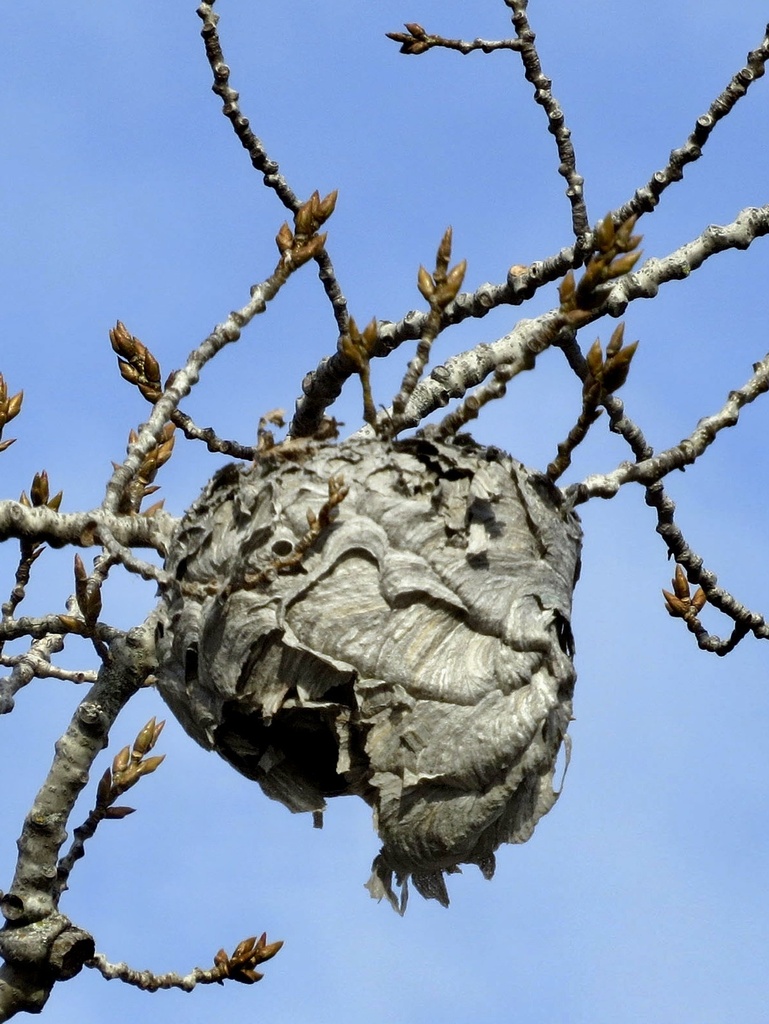
A bald-faced hornet nest is a gray, football- or teardrop-shaped paper nest with a single entrance near the bottom, hanging from a branch, a shrub or the side of a building. The hornets are black with ivory-white markings on the face and the tip of the abdomen. Colonies are smaller than yellowjacket colonies but very defensive. A nest high in a tree away from the house can be left until frost; a nest near a door, a path or at head height is a job for a professional. Do not try to knock it down.
How to recognize the nest
- Closed paper ball. Gray paper with wavy bands in slightly different shades wraps several tiers of comb. You never see open cells from outside; an open umbrella-shaped comb is a paper wasp nest.
- One entrance near the bottom. A round hole, usually at the lower end of the nest.
- Above ground and often in the open. In trees and shrubs, under eaves and soffits, on the side of a shed, a utility pole or a playset. Sometimes surprisingly low, in a hedge or a bush.
- Size: about the size of a tennis ball in early summer, often as big as a football and sometimes a basketball by late summer.
- Visible all of a sudden in fall. Many nests are only noticed once the leaves drop, after the colony has already died.
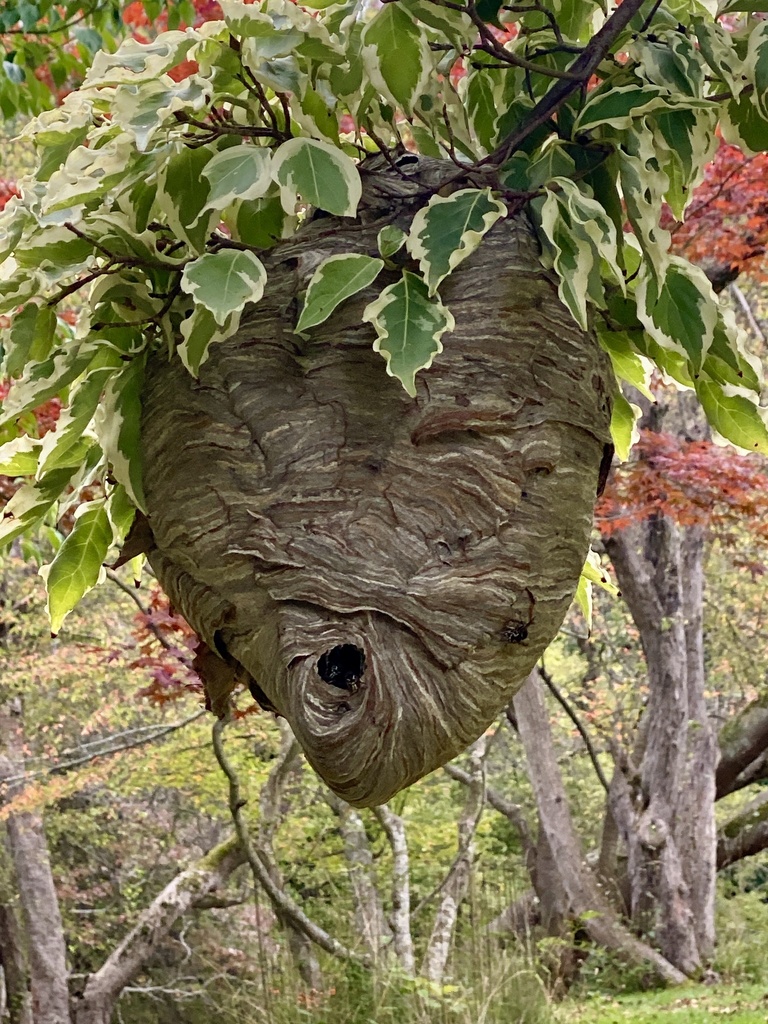
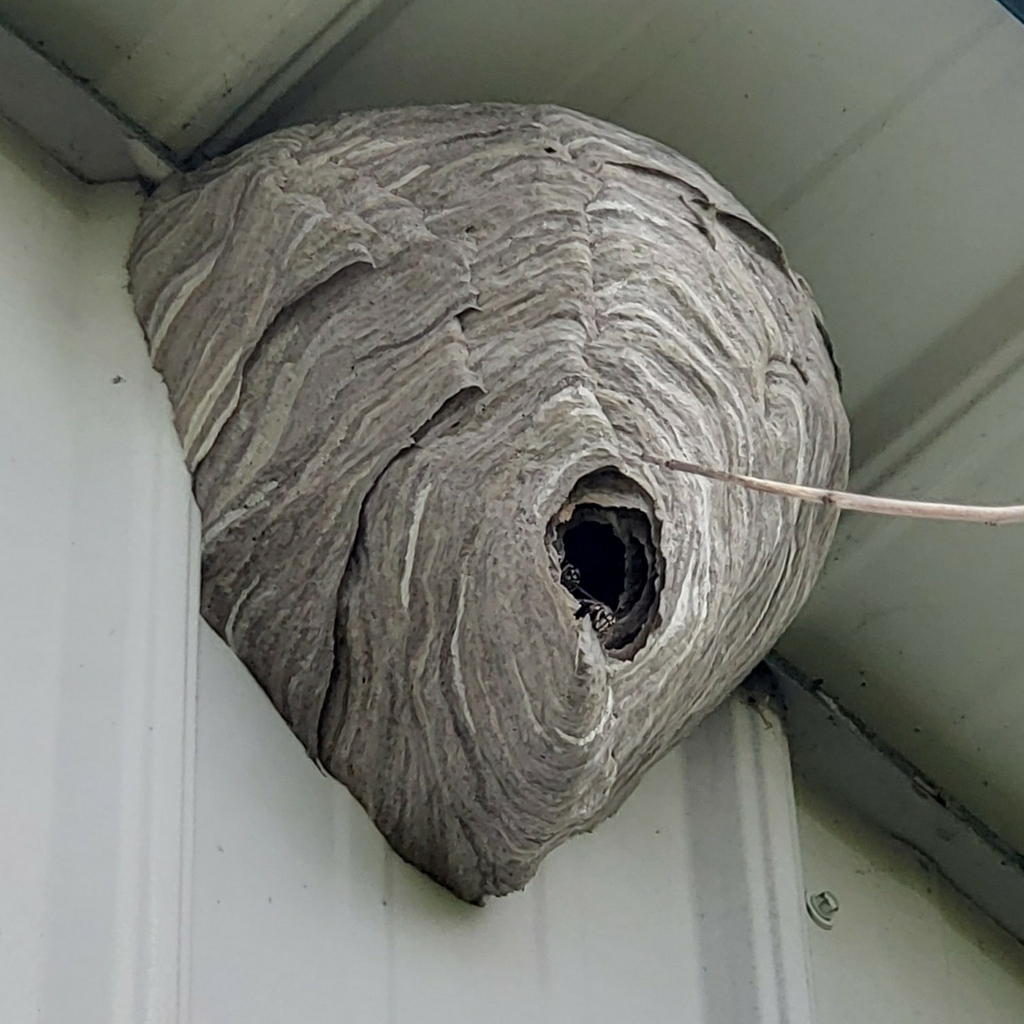
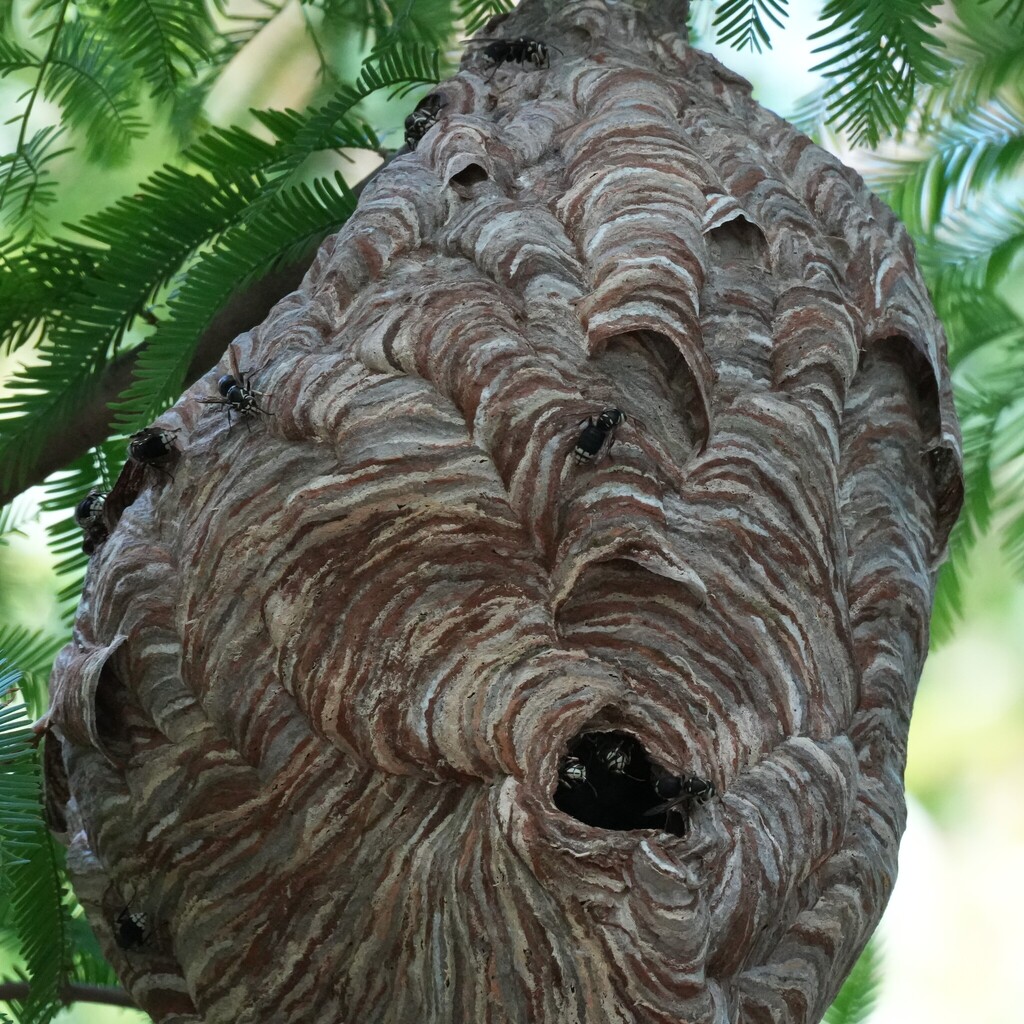
Similar nests: aerial yellowjackets build smaller gray nests in shrubs and under eaves, and most yellowjacket nests are hidden underground or in walls; see yellowjacket nests. A brown nest in a hollow tree or a wall, with large brown-and-yellow insects, may be European hornets. All the common nests side by side: types of wasp nests.
How to recognize bald-faced hornets
Bald-faced hornets are about three-quarters of an inch long, larger than most yellowjackets. They are black with ivory-white markings: a white face, white marks on the thorax and white bands near the tip of the abdomen. There is no yellow on them, which is the quickest way to tell them from yellowjackets.
Despite the name, they are not true hornets. They are a kind of yellowjacket, closely related to the aerial yellowjacket. The only true hornet established in most of the US is the European hornet, which is brown and yellow.
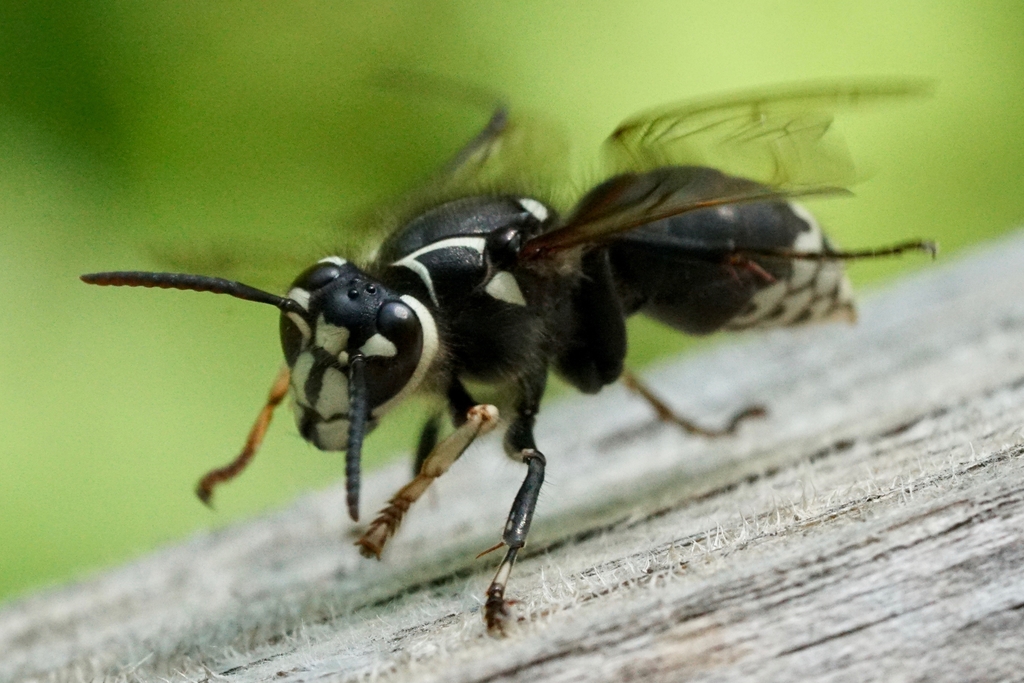
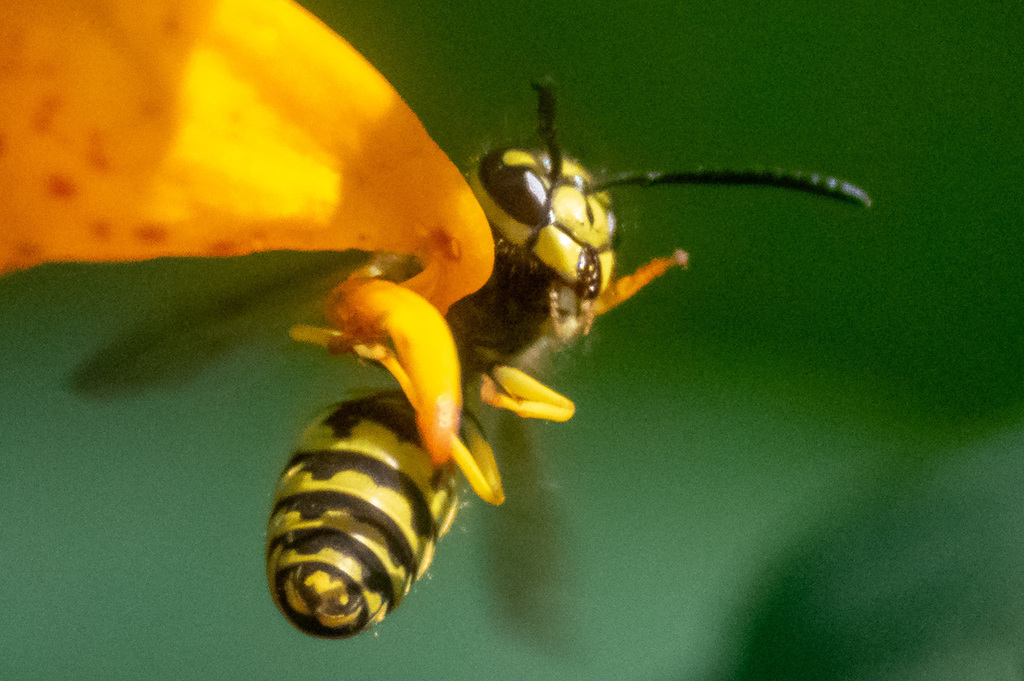
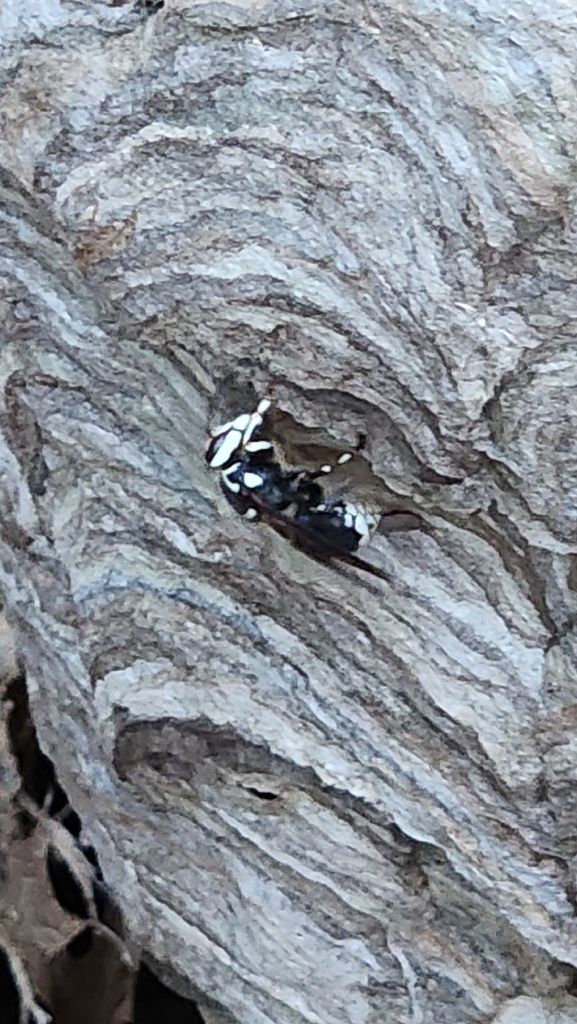
Not sure the insects are wasps at all? Start with wasp vs. bee or bumblebee vs. wasp vs. hornet.
How dangerous is a bald-faced hornet nest?
A colony usually has a few hundred workers at its peak, fewer than a big yellowjacket nest. They are, however, among the most defensive wasps in North America. Guards watch the area around the nest, and vibration, a shadow or movement close to it can bring out many hornets at once. Each one can sting repeatedly, and they may chase an intruder for some distance. They can also spray venom toward the eyes, so eye protection matters even for a pro.
Away from the nest they are not much interested in people. They hunt flies, caterpillars and other insects, including yellowjackets, and rarely bother picnics the way yellowjackets do.
Most stings happen when someone disturbs a nest they have not seen: trimming a hedge, mowing under a low branch, pruning, cleaning gutters or climbing a ladder. Before you trim shrubs or work under trees in late summer, look and listen for traffic. A sting on a ladder is a fall risk.
What to do about a bald-faced hornet nest
Option 1: Leave it until frost
If the nest is high in a tree or far from doors, paths, play areas and work areas, and nobody in the household is allergic, leaving it is usually the safest choice. The colony dies after hard freezes in fall, the hornets eat a lot of pest insects in the meantime, and the nest is never reused. Keep people and mowers well away from it. More on this choice: should you remove a wasp nest or leave it.
Option 2: Call a professional
Call a licensed pest professional if the nest is near a door, a window, a path, the patio or a play area, at head height or in a hedge, high enough that you would need a ladder, or if someone in the household is allergic or the hornets have already stung someone. Professionals have full protective suits and the equipment to treat a nest at height. See when to call a professional for wasps and what hornet nest removal costs.
What about doing it yourself?
We do not recommend removing an active bald-faced hornet nest yourself unless it is very small, early in the season, reachable from the ground and away from the house. Even then, use only a wasp and hornet product labeled for the site, work after dark, wear full protection including eye protection, and keep children and pets inside. Never knock the nest down while it is active, hit it with a stick or a hose, or use fire or fuel. General guidance: how to get rid of a wasp nest safely.
Not sure which option fits? The wasp nest decision guide sorts it out in four questions.
Bald-faced hornets through the year
- Spring: a queen that spent the winter under bark, in a log or in a building starts a small nest alone.
- Summer: workers emerge and the nest grows quickly. By August it can be the size of a football.
- Late summer and early fall: the colony peaks and raises new queens and males. This is when the hornets are most defensive and most stings happen.
- Late fall and winter: after hard freezes the colony dies and the new queens leave to overwinter. The empty nest often stays in the tree, weathering and falling apart over the winter. It is not reused. Not sure whether a nest is still in use? See how to tell if a wasp nest is still active.
Allergic to stings?
If anyone in your household is allergic to bee or wasp stings, do not try to deal with a nest yourself. In an emergency, such as trouble breathing or swelling of the face or throat after a sting, call 911 and use a prescribed epinephrine auto-injector if one is available.
Common questions
Are bald-faced hornets really hornets?
No. They are a kind of yellowjacket. The name comes from their size and their white “bald” face.
Do bald-faced hornets reuse their nest?
No. Each spring a new queen builds a new nest, usually somewhere else. An empty nest found in winter can be knocked down and thrown away.
Should I remove an empty nest?
You can, once you are sure the colony is gone: after several hard freezes and with no hornets flying in or out for a week or more. Some people keep them as a curiosity.
Can I spray the nest from the ground?
A wasp and hornet spray can reach a nest several feet away, but a large nest high in a tree is hard to treat completely, and a partly treated colony is very defensive. For anything larger than a softball or out of easy reach, call a professional. Choosing a product: how to choose a wasp and hornet spray.
Do bald-faced hornets sting more than once?
Yes. Like other wasps, each hornet can sting repeatedly. If you are being chased, walk or run away quickly, cover your face and get indoors; do not swat or jump into water.
Your next step
- Decide what to do: the wasp nest decision guide.
- Compare with other nests: types of wasp nests, yellowjacket nests and paper wasp nests.
- All identification guides: wasp and nest identification.
- Been stung? Here is what to do first.
Photos on this page are shared by their authors on iNaturalist under Creative Commons licenses, credited under each image. For who writes these guides and how we stay independent, see About.