
Decision Guide
What to do about a wasp nest
Finding a wasp nest next to your door or under the deck is unsettling, and most of what you read online either sells you a spray or a service before you know what you are dealing with. This guide works the other way round. It helps you figure out what kind of nest you have and how risky it is, then points you to the right next step: leave it alone, handle a small nest yourself, call a beekeeper, or call a professional.
Use this guide to decide whether to identify first, leave the nest, remove a small nest yourself, call a beekeeper, or call a licensed pest professional.
Work through the four questions below. At the end you will land on one of five results. Each result explains when it fits, when it does not, and what to do next.
In a sting emergency, call 911
Call 911 right away if someone who was stung has trouble breathing, swelling of the lips, tongue or throat, hives spreading beyond the sting, dizziness or fainting, or has been stung many times. If they carry a prescribed epinephrine auto-injector, use it as directed. Do not wait to see if it gets better.
A note before you start: wasp nests involve stings, pesticides and, sometimes, ladders. This guide is educational and does not replace the product label or a professional’s assessment of your home. When a situation looks serious, unclear or high-risk, the safest answer is a professional. We would rather send you to a pro you did not strictly need than talk you into a DIY job that was over your head.
Find your safest next step
Four short questions. The guide suggests a route; it does not identify a species from a photo.
Step 1 of 4
What are you seeing?
Choose the closest match. If you cannot tell, choose “Not sure”.
Where is the nest?
Pick the main location.
What are you trying to do?
Choose your main goal right now.
Do any of these apply?
Choose all that apply, or “None of these”.
The four questions
Prefer to read it yourself, or have JavaScript turned off? Here is the complete manual version. Answer all four questions, then use your answers with “How to read your answer” below. The interactive guide follows exactly the same rules.
Question 1: What are you seeing?
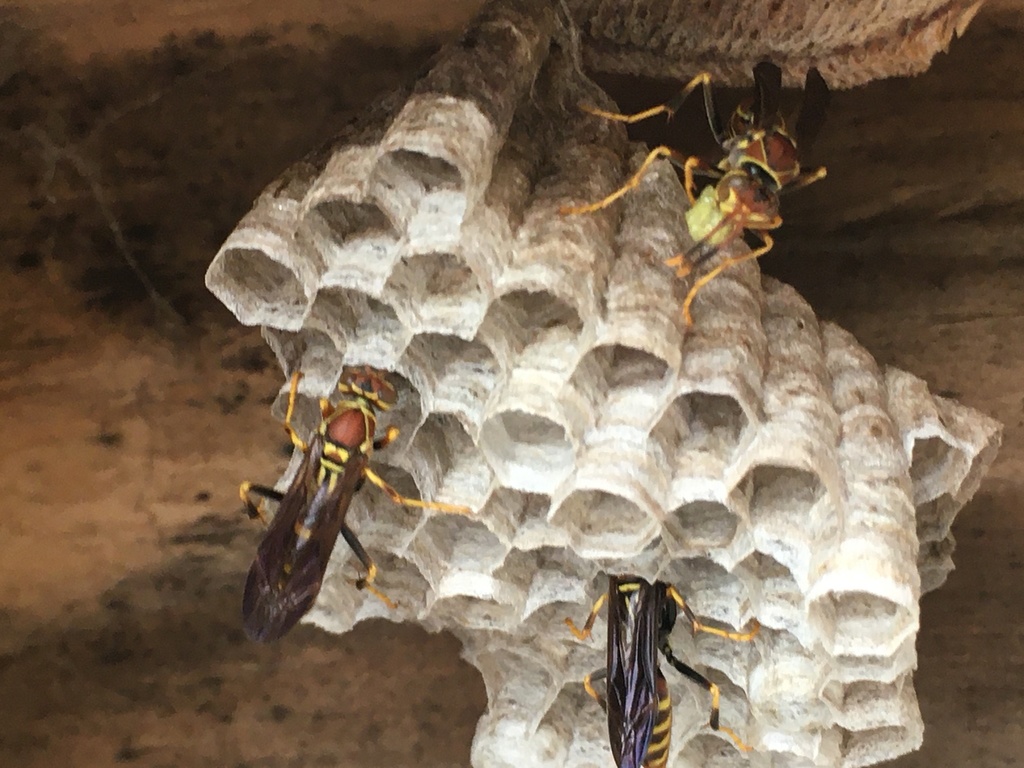
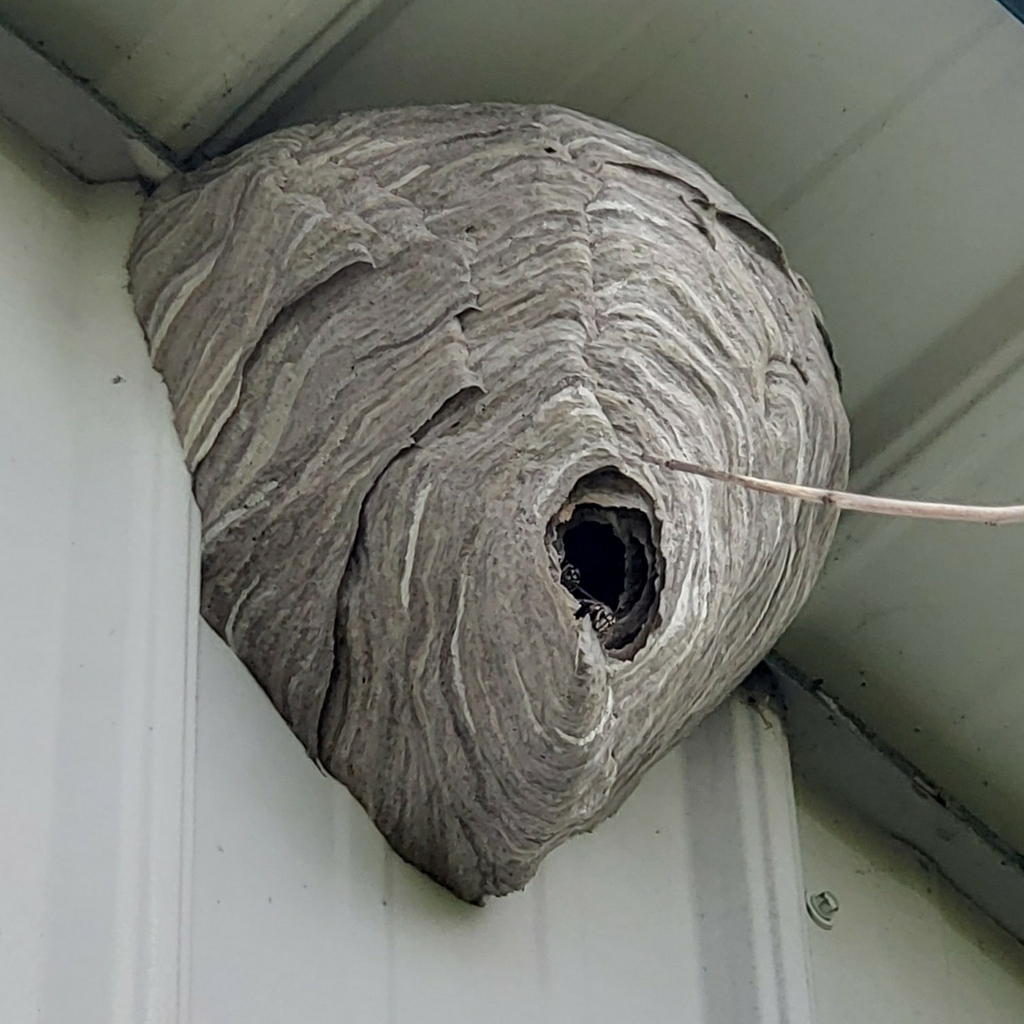
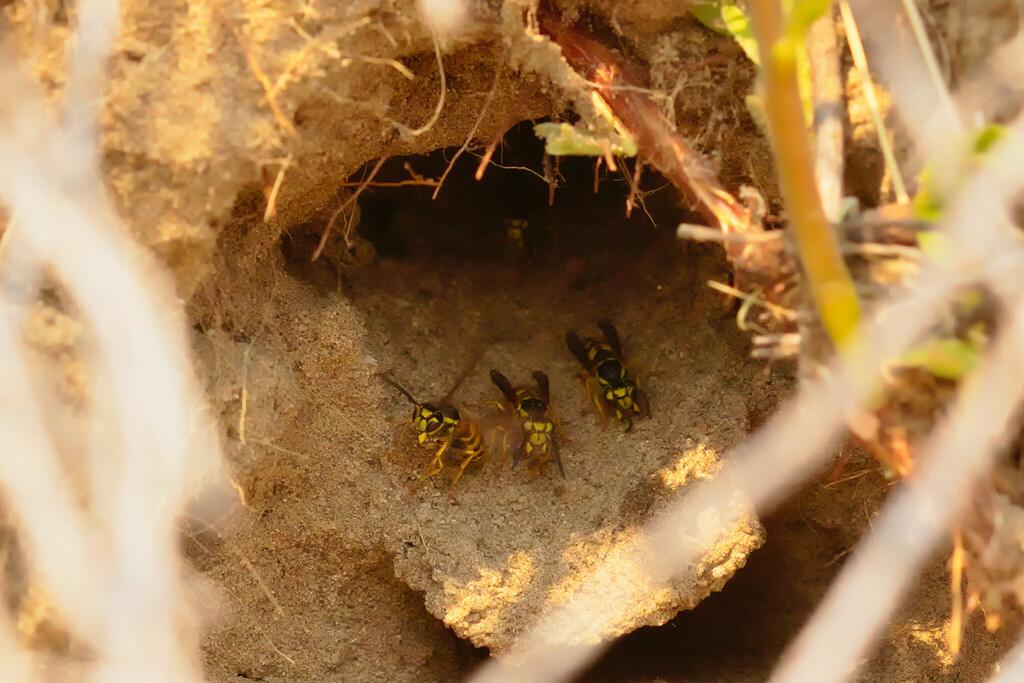
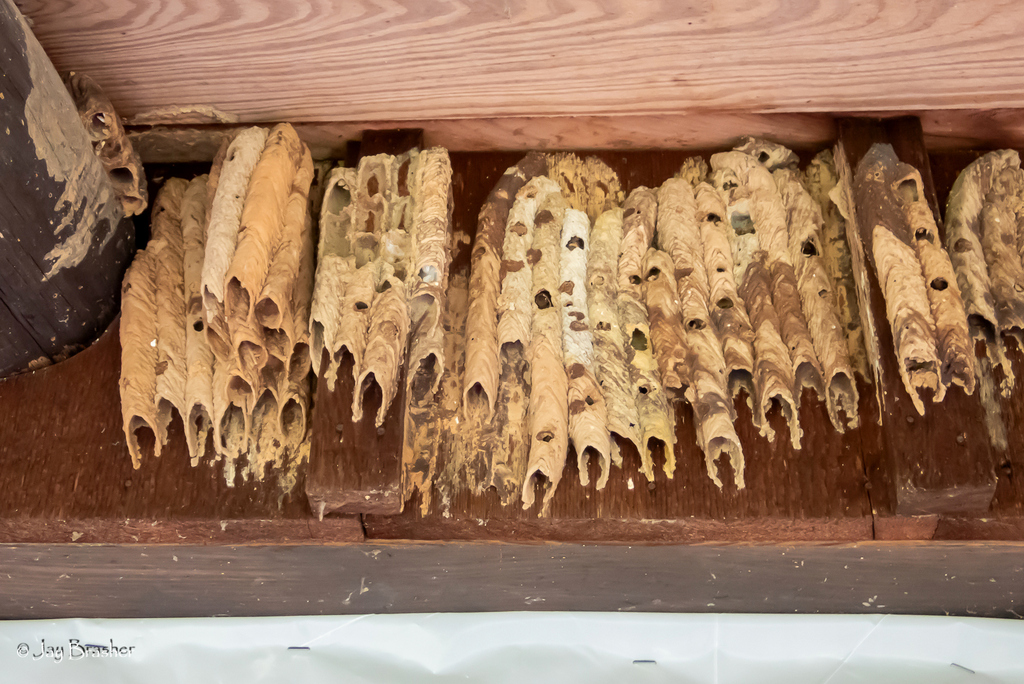
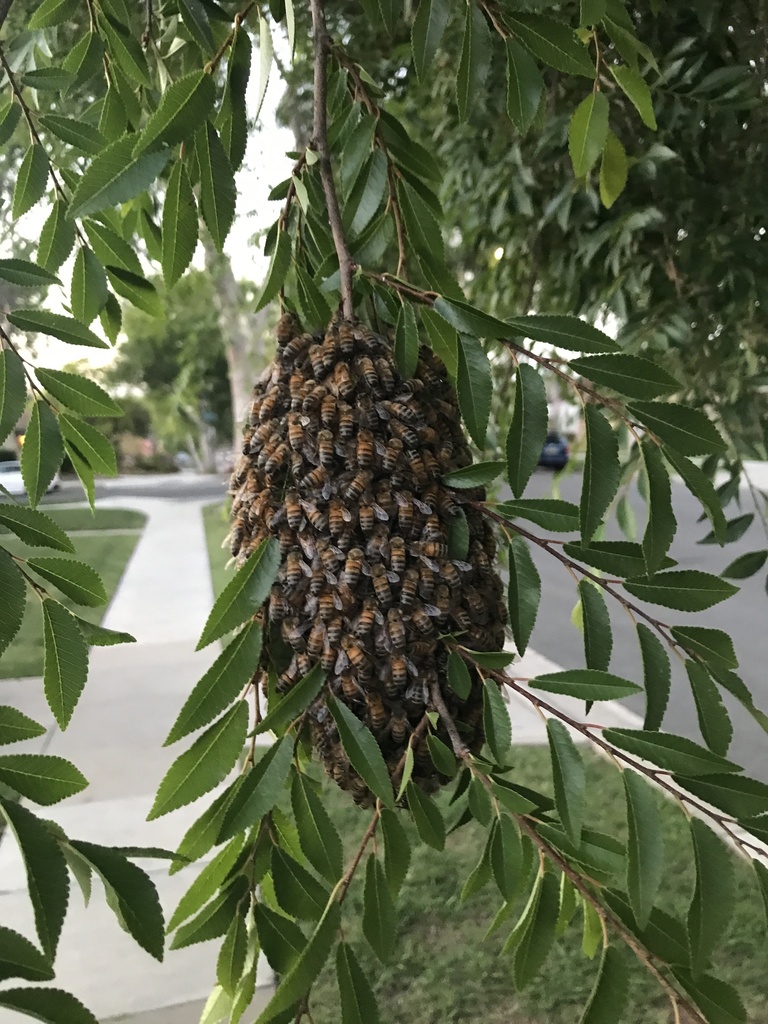
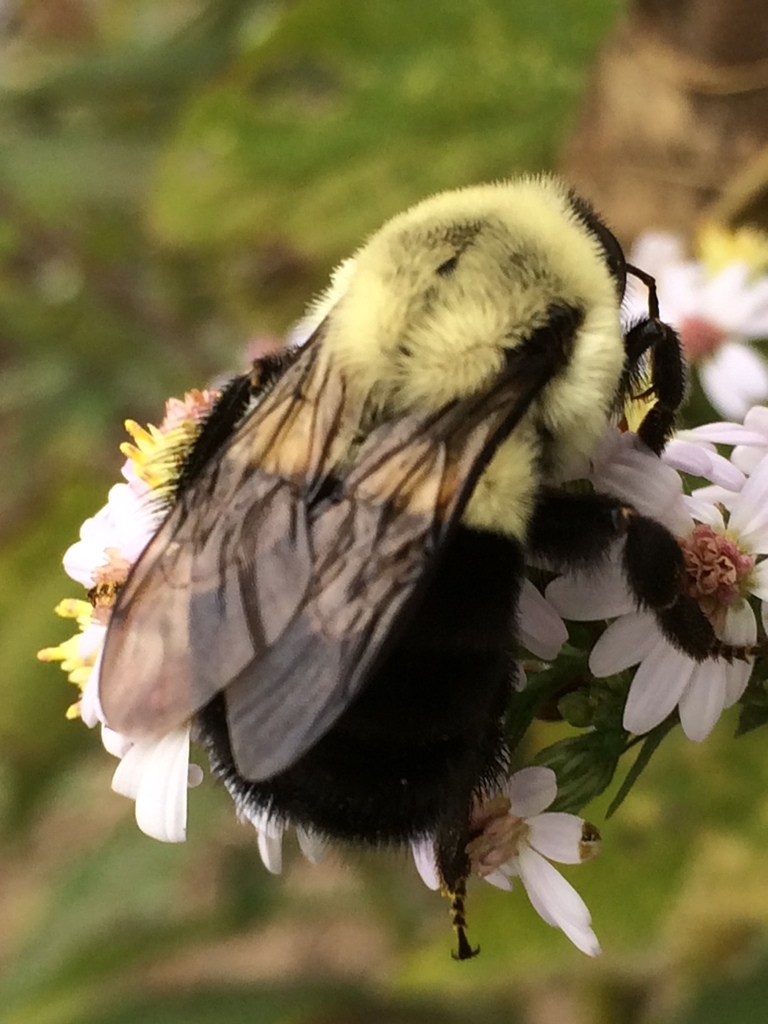
Six common sights, with photos shared under Creative Commons licenses (tap a photo to enlarge). Full identification guides are linked in Result A.
- An open, umbrella-shaped paper comb with visible cells, hanging from a stalk (usually paper wasps)
- A closed gray paper ball or “football” with one entrance hole (usually bald-faced hornets or aerial yellowjackets)
- Wasps flying in and out of a hole in the ground (often yellowjackets)
- Wasps going in and out of a gap in the house: siding, soffit, roof edge, vent or wall
- Mud tubes or mud “organ pipes” (usually mud daubers)
- Fuzzy bees, a hanging cluster of bees, or wax comb (honey bees or bumblebees)
- Not sure
Not sure whether you are looking at wasps or bees? Start with wasp vs. bee: how to tell the difference and the photo guide to wasp nest types.
Question 2: Where is the nest?
- Outside, reachable from the ground (eaves, railings, deck, shed, outdoor furniture)
- Outside, high up (needs a ladder or roof access)
- In the ground
- In a tree, shrub or hedge
- Inside the structure: a wall, attic, chimney, crawl space, or wasps inside the house
- Not sure where the nest is
Question 3: What are you trying to do?
- Find out what it is
- Leave it alone if that is safe
- Remove it myself
- Have someone remove it
Question 4: Do any of these apply? (Choose all that apply)
- Someone in the household is allergic to stings, has had a severe reaction, or carries an epinephrine auto-injector
- The nest is bigger than a softball, or you cannot see how big it is
- Reaching it would mean a ladder, a roof or a crawl space
- Wasps have already stung someone or chase people near the nest
- You are not comfortable reading and following a pesticide label
- The nest is a few steps from a door, path, play area or pet area
- None of these
How to read your answer
Start at the top and stop at the first rule that matches you. This is exactly the order the interactive guide uses.
- Bees (Question 1) → Result B: It’s bees, don’t spray. Honey bees and bumblebees need a different plan from wasps.
- Any high-risk box in Question 4 → Result E: Call a professional. That means an allergy, a large or hidden nest, a ladder or crawl space, wasps that already sting or chase people, or discomfort with pesticide labels. High-risk conditions override everything else, on purpose.
- A nest inside the structure or high up (Question 2), or wasps using a gap in the house (Question 1) → Result E. Hidden and hard-to-reach nests are where DIY goes wrong.
- Your goal is “have someone remove it” → Result E.
- Not sure what it is or where it is, or your goal is “find out what it is” → Result A: Identify it first. Do not buy a spray for a problem you have not confirmed.
- Your goal is “leave it alone”: if the nest is not near a door, path, play area or pet area → Result C: Leave it alone. If it is near one of those, leaving it is not the safe option; go to Result D, below.
- Your goal is “remove it myself” (or rule 6 sent you here) → Result D: Careful DIY for a small, reachable nest. By this point the guide has already filtered out the high-risk situations.
If two results seem to fit, choose the one higher on the list. Safety and certainty come before convenience.
Result A
Identify it first
Short answer: do not spray anything yet. Find out what the insect is and where the nest actually is.
The most common mistake with stinging insects is treating the wrong thing. Honey bees get sprayed when a beekeeper would have taken them for free. Harmless mud daubers get blasted with pesticide. An empty paper nest from last year gets “treated” in a panic. A few minutes of careful identification, from a safe distance, saves money and stings.
When this fits you
- You are not sure whether you are looking at wasps, hornets or bees.
- You can see insects but not the nest itself, and the location is not inside the house.
- You want to know what it is before deciding anything.
When this does not fit you
- Wasps are coming out of a wall, the attic or inside the house → see Result E.
- Someone has been stung or is allergic → see Result E.
Your next step
- Learn the basic differences in wasp vs. bee and bumblebee vs. wasp vs. hornet.
- Match the nest shape in types of wasp nests.
- Then read the guide for your nest: paper wasp nests, yellowjacket nests, bald-faced hornet nests or mud dauber nests.
Or browse all identification guides.
Watch from at least 10 to 15 feet away, do not block the entrance, and do not poke the nest to “see what comes out”. Phone zoom is your friend. Once you know what you have, come back and run the guide again.
Result B
It’s bees: don’t spray
Short answer: bees are not a pest-spray job. A swarm or a colony of honey bees can usually be collected alive, and bumblebees are often best left alone.
Bees and wasps need different plans. Honey bees build wax comb, not paper, and a colony in a wall leaves comb and honey behind if it is simply killed, which can lead to stains, odors and other pests later. Bumblebee colonies are small, last one season and are usually calm unless disturbed.
When this fits you
- You see a cluster of bees hanging from a branch, fence or eave. This is usually a honey bee swarm resting while scouts look for a new home.
- You see wax comb, or bees going in and out of a wall or tree cavity.
- You see large, fuzzy bumblebees using a hole in the ground, a compost pile or old insulation.
When this does not fit you
- The insects are smooth, shiny and have a narrow “waist” with bright yellow and black bands → those are likely wasps; go back to Result A.
- Someone in the household is allergic and the bees are in a high-traffic spot → you still should not spray, but call a bee removal specialist promptly rather than waiting.
Your next step
- Swarm on a branch or fence: keep people and pets away and contact a local beekeeper or your state or county beekeepers’ association, many of which keep swarm-collection lists. Swarms often move on within a day or two on their own.
- Honey bees living in a wall, roof or tree: call a live bee removal specialist. Removing the comb matters as much as removing the bees.
- Bumblebees: if the nest is away from doors and paths, the simplest option is to leave it. The colony dies off at the end of the season.
- Not sure? See wasp vs. bee.
Result C
Leave it alone
Short answer: if the nest is away from where people and pets go, and nobody is allergic, leaving it is often the safest and cheapest option.
Most wasp nests in the US are annual. In most of the country the colony dies after the first hard freezes in fall, only new queens survive the winter somewhere else, and the old nest is not reused. Meanwhile paper wasps and many other wasps hunt caterpillars and other garden pests. A nest at the far corner of the yard or high in a tree that nobody walks under is often not worth the risk of removing.
When this fits you
- The nest is not near a door, path, deck, play area or pet area.
- Nobody in the household is allergic to stings.
- The wasps ignore people at a normal distance.
- It is late in the season, or the nest is small and out of the way.
When this does not fit you
- The nest is a few steps from where people pass → see Result D or Result E.
- The wasps are yellowjackets in the ground next to a lawn you mow → these get more defensive as the colony grows in late summer; see yellowjacket ground nests.
- Wasps are inside the house or wall → see Result E.
Your next step
- Still weighing it up? See should you remove a wasp nest or leave it.
- Mark the area and tell everyone in the household, including visitors and anyone who mows.
- Keep sweet drinks, fruit and uncovered trash away from that part of the yard in late summer.
- After a few hard frosts, check that the nest is quiet. An empty paper nest can then be knocked down and bagged. See the best time to remove a wasp nest.
- Next spring, use simple prevention steps to make the spot less attractive to new queens.
Result D
Careful DIY for a small, reachable nest
Short answer: a small, exposed nest you can reach from the ground can often be handled yourself, with a product labeled for wasps, at the right time of day, and with a clear way out.
This path is for homeowners with no sting allergy in the household, a nest no bigger than a softball, and a spot that does not need a ladder. Small paper wasp nests early in the season are the classic example. Old mud dauber nests usually just need scraping off; most are already empty, and mud daubers rarely sting.
When this fits you
- No one in the household is allergic to stings.
- The nest is exposed, smaller than a softball, and reachable while standing on the ground.
- You are comfortable reading and following a pesticide label exactly.
When this does not fit you
- Any high-risk condition from Question 4 applies → see Result E.
- The nest is inside a wall, an attic or a void → see Result E, and do not seal the entrance. Trapped wasps can chew through to the inside of the house. See wasp nests in walls.
The basics, before you start
- Read the whole label first. The label is the law: it tells you which pests and sites the product is for, how far to stand and what protection to wear.
- Work at dusk or after dark, when the wasps are back in the nest and less active. Do not shine a bright white light straight at the nest; a flashlight with a red filter is less likely to draw wasps toward you.
- Cover up: long sleeves and pants, gloves, closed shoes and eye protection. Keep children and pets indoors.
- Plan your exit: know where you will walk away to, with nothing to trip over.
- Wait before removing the nest. Give it at least a day, check that there is no activity, then knock it down and bag it.
- Ground nests are harder. The entrance is easy to miss and the colony can be much bigger than it looks. Never plug the hole or step on it. Read how to deal with a yellowjacket ground nest first, and call a pro if you have any doubt.
Never use fire, gasoline or other fuels on a wasp nest, and do not try to flood a ground nest with water. These methods cause burns, house fires and ground contamination, and they often leave angry wasps behind.
Your next step
- Step-by-step instructions: how to get rid of a wasp nest safely and how to remove a paper wasp nest.
- Choosing a product: how to choose a wasp and hornet spray.
- Still on the fence? Compare DIY vs. professional removal.
Where a product fits here: a wasp and hornet spray or dust that is labeled for your site is the natural fit. If, when you get close, the nest turns out bigger or more hidden than you thought, stop and switch to Result E.
Result E
Call a licensed pest professional
Short answer: this is not a good DIY job. A licensed pest control professional has the equipment, products and experience to deal with it safely.
Some nests are not worth the risk. A sting allergy turns a bad afternoon into a medical emergency. A large yellowjacket or hornet colony can hold far more insects than you can see from outside. Nests inside walls or attics are hard to reach without making things worse, and working on a ladder while being stung is how people get badly hurt. Calling a professional here is not overreacting; it is usually the cheapest way to avoid a much bigger problem.
When this fits you (any one is enough)
- Someone in the household is allergic to stings.
- The nest is larger than a softball, or you cannot see how big it is.
- The nest is inside a wall, attic, chimney or crawl space, or wasps keep turning up inside the house.
- Reaching the nest would mean a ladder or the roof.
- The wasps have already stung someone or chase people.
- You are not comfortable reading and following pesticide labels.
When something lighter might fit
If none of the above apply and you only want to know what you are looking at, start with Result A. When in doubt between A and E, choose E.
Your next step
- What makes a job a pro job: when to call a professional for wasps.
- What to expect to pay: how much wasp nest removal costs.
- Wasps inside? Read wasps in the house: where they come from and why not to seal a wall nest before anyone patches a hole.
Until the professional arrives, keep people and pets away from the nest, do not block entrances, and do not spray a nest you cannot fully see. If wasps are getting into the house, keep the door to that room closed.
Where a professional fits here: the honest way we help on this path is connecting you with a qualified local professional and giving you questions to ask. We do not push sprays into situations where DIY is the wrong call.
One last thing
No four-question guide can cover every yard and every nest. If your situation feels borderline, treat that feeling as information: borderline wasp nests are exactly the ones where a professional pays for itself. And if you are stung, here is what to do first.
For who writes these guides and how we stay independent, see About. For how affiliate links work on this site, see our Affiliate Disclosure.