
Yellowjacket nests: ground, wall and attic
Yellowjackets cause more stings around American homes than any other wasp, and most of those stings start at a nest nobody knew was there: a hole in the lawn, a gap in the siding, a vent into the attic. This guide shows how to recognize a yellowjacket nest in each of those places, why it gets more dangerous as summer goes on, and what your options are.
Short answer
A yellowjacket nest is a closed ball of gray paper with a single entrance, usually hidden underground, inside a wall or in an attic. From outside you often see only a hole or a crack with a steady stream of fast, compact yellow-and-black wasps flying straight in and out. By late summer a colony can hold thousands of workers that defend the nest hard. A ground nest far from where people walk can sometimes be left until frost; a nest next to a path, in a wall or in the attic is usually a job for a professional.
How to recognize a yellowjacket nest
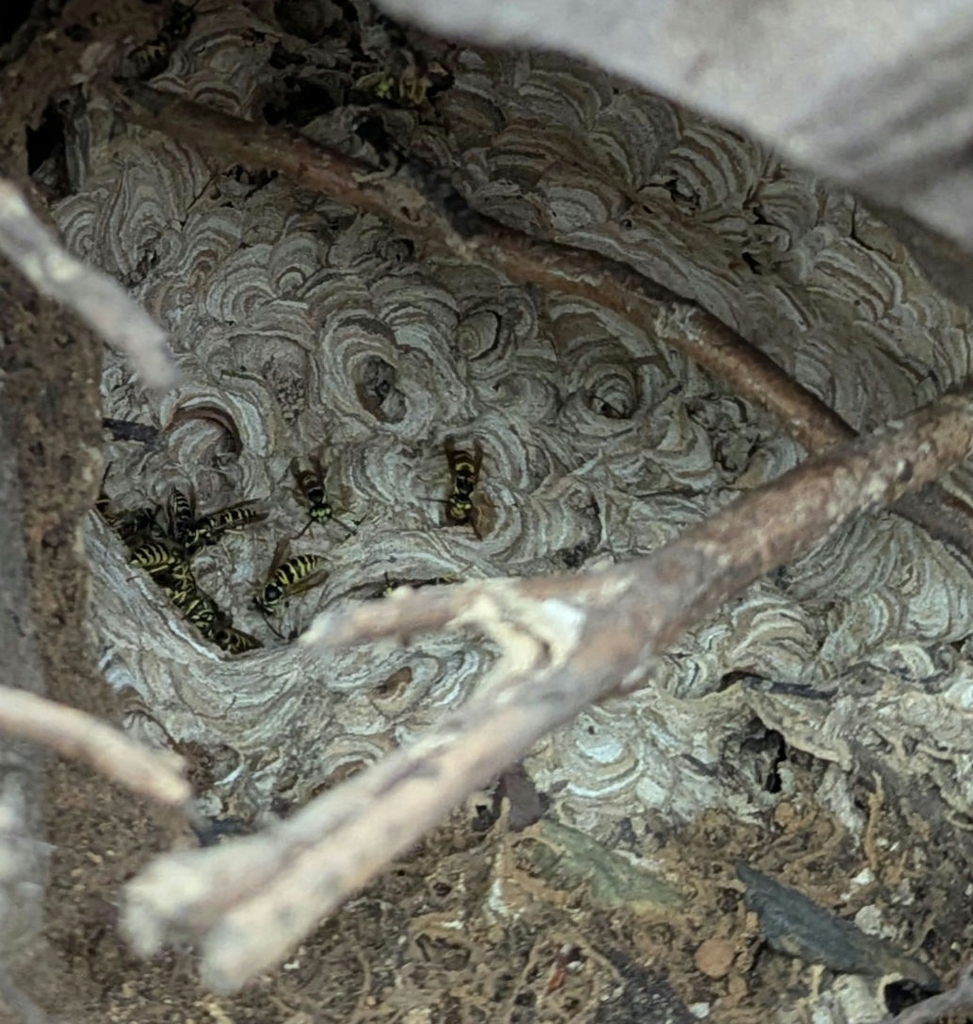
- A closed paper envelope. Gray or tan paper with a scalloped, shell-like pattern wraps several tiers of comb. You never see open cells from outside; an open comb on a stalk is a paper wasp nest.
- One entrance. All the traffic goes through a single opening: a hole in the ground, a gap in the siding or a hole at the bottom of an exposed nest.
- Usually hidden. Most nests are out of sight: in old rodent burrows, under rocks, roots and landscape timbers, in wall voids, crawl spaces, attics and sheds. Fewer are built in the open, in shrubs or under eaves.
- Size: about the size of a golf ball in spring, often as big as a football or larger by late summer, most of it out of view.
- Constant traffic. On a warm afternoon workers fly in and out every few seconds, straight and fast, without hovering.
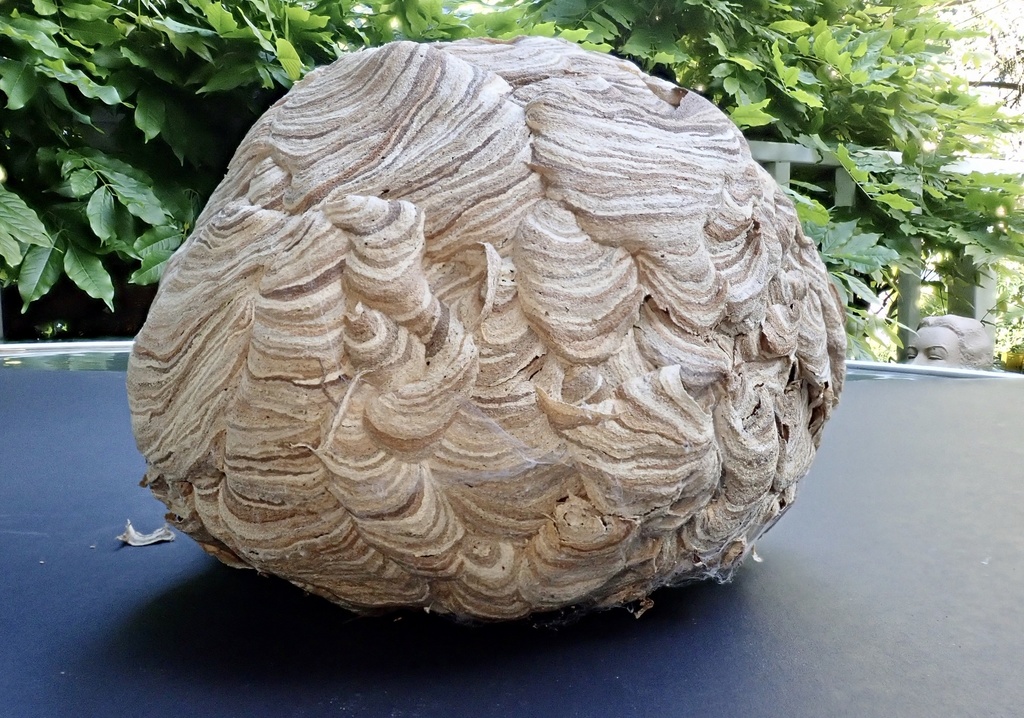
A gray, football-shaped nest hanging in a tree or from the eaves, with black-and-white wasps, is more likely a bald-faced hornet nest. All the common nests side by side: types of wasp nests.
How to recognize yellowjackets
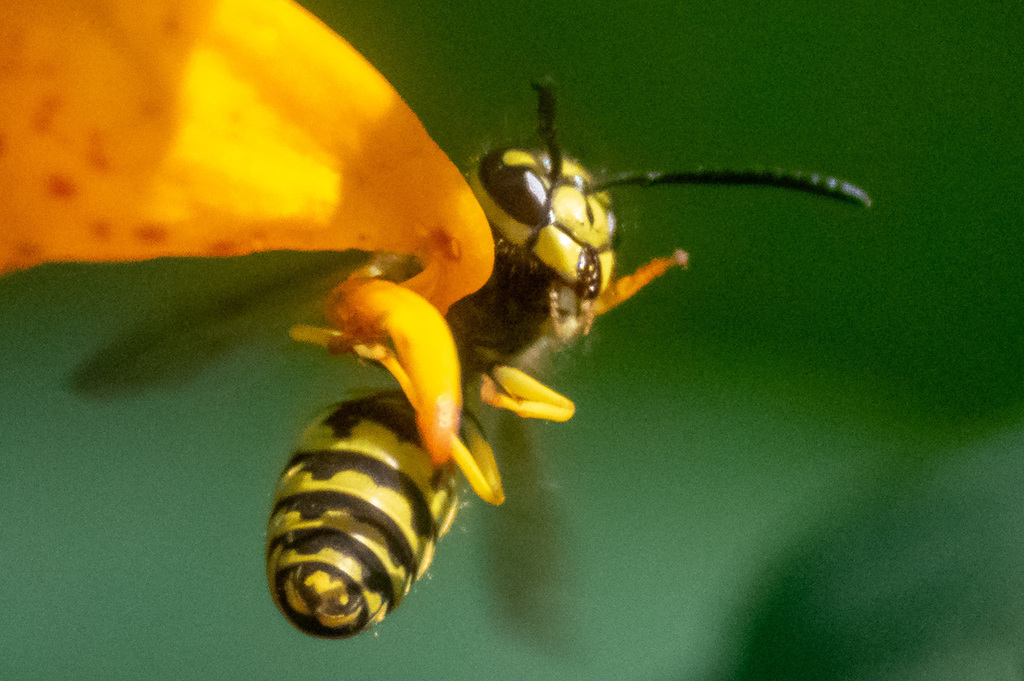
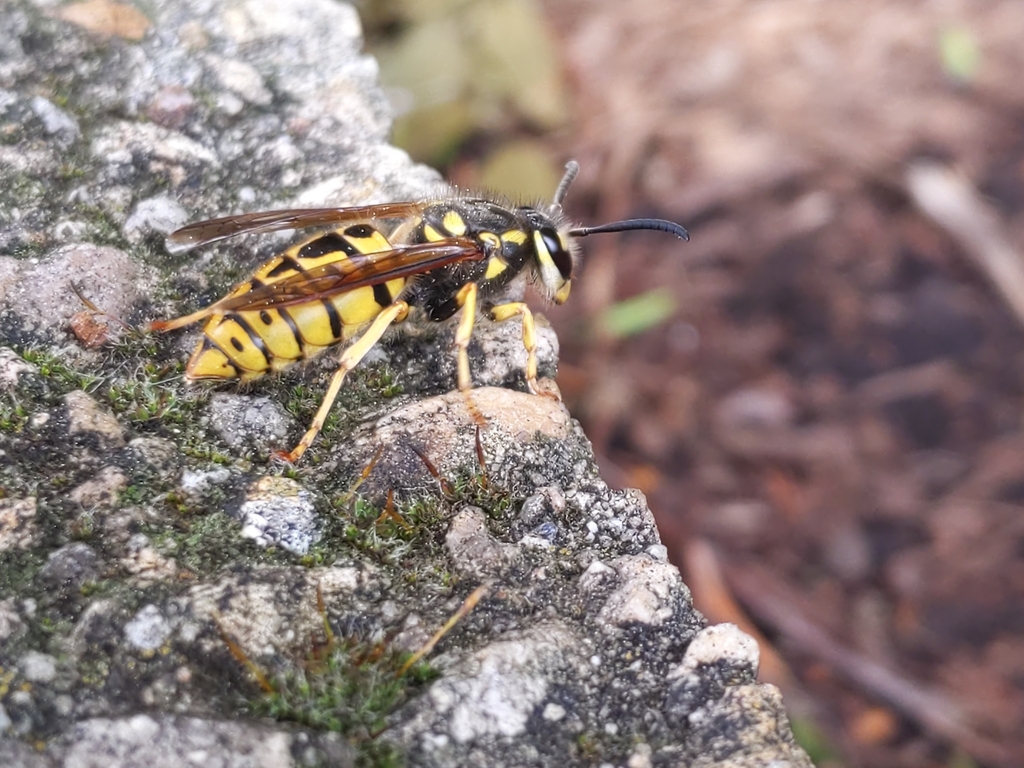
Yellowjackets are compact, smooth and shiny, with bold yellow-and-black bands, black antennae and short legs tucked in when they fly. They are about the size of a honey bee but not fuzzy, and they fly fast and in quick zigzags. If you are not sure the insects are wasps at all, start with wasp vs. bee. The species you are most likely to meet:
- Eastern yellowjacket: east of the Great Plains. Nests mostly underground.
- Western yellowjacket: the West. Nests mostly underground; a familiar visitor at picnics and campsites.
- German yellowjacket: introduced from Europe and now widespread. Often nests inside buildings: wall voids, attics, crawl spaces.
- Southern yellowjacket: the Southeast. Ground nests; in the warmest areas some colonies survive the winter and grow very large.
- Aerial yellowjacket: builds exposed paper nests in shrubs and under eaves.
Yellowjacket nests in the ground
This is the most common kind. In spring the queen picks an abandoned rodent burrow, a hollow under a root, a rock or a landscape timber, or a gap under a slab, and the workers enlarge the cavity as the nest grows. Signs to look for:
- a single hole, often half an inch to an inch across, sometimes with bare soil around it;
- wasps flying low and straight into the hole and out of it;
- a busy spot in the lawn, a mulch bed, at the edge of a patio or along a foundation.
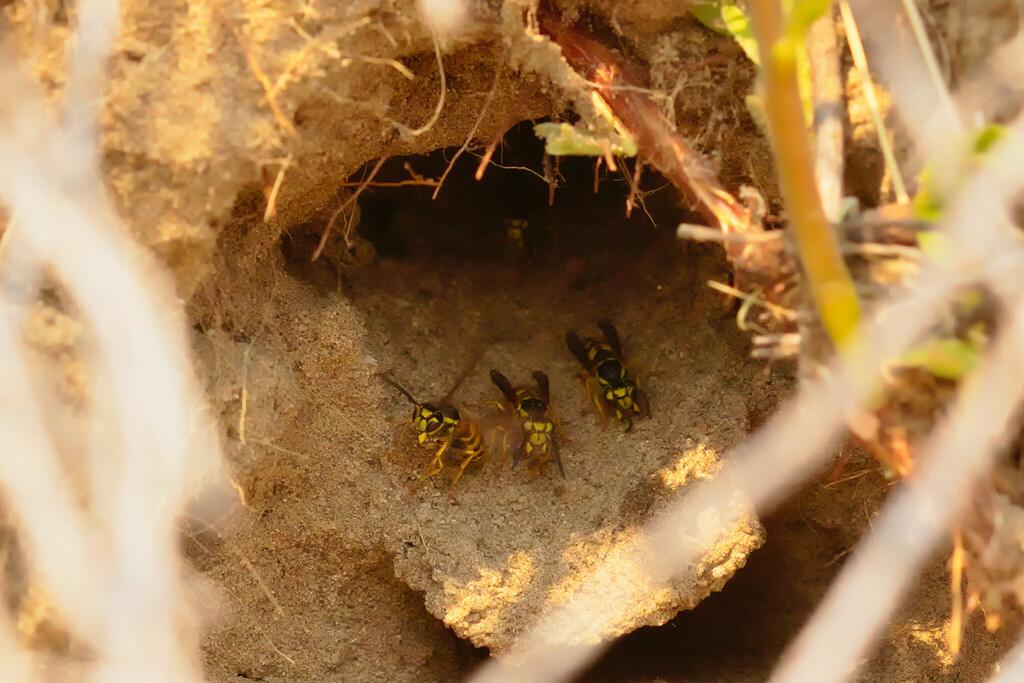
Ground nests cause a lot of stings because people find them by accident: mowing, string-trimming, weeding or simply stepping near the hole. Vibration or a shadow over the entrance can bring dozens of defenders out at once.
- Mark the hole from a distance with a flag or a cone, and keep children and pets away.
- Do not pour gasoline, bleach or boiling water into the hole, and do not plug it. The colony usually survives, and the wasps come out defensive or dig a new exit.
- Leave a buffer when you mow until the nest is dealt with.
Step-by-step instructions: how to get rid of a yellowjacket ground nest. Many small holes with little mounds of soil and calm insects are more likely ground-nesting bees; see bees or wasps nesting in the ground.
Yellowjacket nests in walls
Yellowjackets, German yellowjackets in particular, move into wall voids through gaps in siding, trim, soffits and brick weep holes, around pipes and wires, or where a deck meets the house. Signs of a nest in a wall:
- wasps going in and out of one gap in the siding, trim, brick or foundation;
- a rustling or crackling sound inside the wall;
- yellowjackets turning up indoors, near outlets, light fixtures or windows;
- in bad cases, a damp or discolored spot on the drywall where the nest is pressing through.
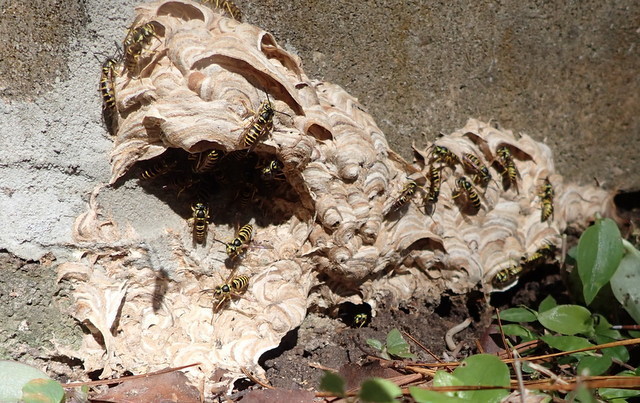
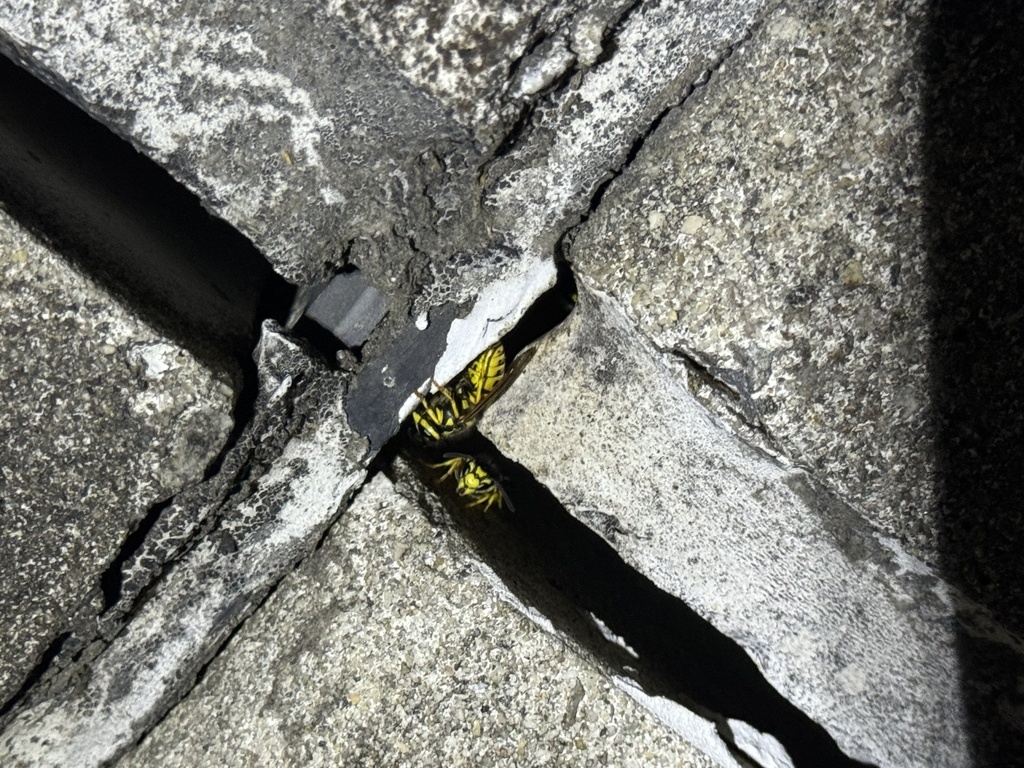
Do not seal the entrance of an active wall nest. Trapped yellowjackets look for another way out and can chew through drywall into the house. A nest in a wall is a job for a professional; more in wasp nest in a wall.
Yellowjacket nests in attics and sheds
Attics, crawl spaces, sheds and garages give a nest room to grow, and an undisturbed attic nest can end up larger than a basketball. The wasps usually get in through a soffit or gable vent, a gap at the roofline or a torn screen, so the first thing you notice is often traffic at a vent. Inside, the gray nest sits on rafters, joists or in the insulation.
Do not try to remove an attic nest yourself. The space is cramped, the footing is poor, and the only way out may lead through the wasps’ flight path. Call a licensed pest professional.
Yellowjacket nests above ground
Aerial yellowjackets, and sometimes eastern and German yellowjackets, build exposed gray nests in hedges and shrubs, under eaves, decks and porch roofs. They look like a smaller version of a bald-faced hornet nest. A nest inside a hedge is often found by the hedge trimmer, so check dense shrubs for traffic before trimming in late summer.
Where is the nest? Quick guide
| Where | What you see | Risk | What to do |
|---|---|---|---|
| Lawn or garden bed | A hole with steady traffic | High near paths and where you mow | Mark it. A small nest away from the house may be DIY; otherwise call a pro |
| Under a slab, step or timber | Wasps entering a gap at ground level | High, and hard to treat | Professional |
| Wall | Wasps entering a crack; noise inside | High; wasps can get into the house | Professional. Do not seal the gap |
| Attic or crawl space | Traffic at a vent; nest on rafters | High; nests get large | Professional |
| Shrub, eaves or deck | A gray paper ball | Medium to high | Leave it if it is far away; otherwise a pro |
How dangerous is a yellowjacket nest?
More dangerous than a paper wasp nest. A colony is small in spring, but by August and September it commonly has thousands of workers. Each one can sting more than once, and a disturbed nest releases an alarm scent that brings out more defenders. In late summer workers also start hunting for sugar and protein, so they turn up at picnics, trash cans and open drinks, and stings away from the nest become more common too.
What to do about a yellowjacket nest
Option 1: Leave it until frost
If the nest is far from paths, doors, play areas and the part of the yard you mow, and nobody in the household is allergic, you can leave it. In most of the country the colony dies after the first hard freezes, and the nest is never reused. Mark the spot so nobody stumbles on it. More on this choice: should you remove a wasp nest or leave it.
Option 2: Treat a small ground nest yourself
Weighing DIY against a pro? See DIY vs. professional removal. Only for a nest in the ground, in the open, with an entrance you can reach without standing right over it, and only if nobody in the household is allergic. The basics:
- Use a product whose label lists yellowjackets and ground nests, and read the whole label first. The label is the law.
- Work after dark, when the wasps are inside. Use a red light or keep the flashlight off the entrance.
- Wear long sleeves, long pants, gloves and eye protection, keep children and pets inside, and plan your way back to the house.
- Check the entrance for activity over the next few days before you consider the job done.
Step-by-step instructions: how to get rid of a yellowjacket ground nest. Timing matters: the best time to remove a wasp nest.
Never use fire, gasoline or other fuels, do not flood the hole, and do not block the entrance of any yellowjacket nest. These methods cause injuries and house fires and rarely kill the colony.
Option 3: Call a professional
Call a licensed pest professional if the nest is in a wall, attic, crawl space or under a slab, if it is large or next to a door or path, if someone in the household is allergic, or if the wasps have already stung someone. See when to call a professional for wasps and what wasp nest removal costs.
Not sure which option fits? The wasp nest decision guide sorts it out in four questions.
Yellowjackets through the year
- Spring: a queen that spent the winter in a sheltered spot starts a nest alone. It is small and there are few wasps; see how to prevent wasp nests.
- Summer: workers take over and the nest grows fast, mostly out of sight.
- Late summer and fall: the colony peaks and raises new queens and males. This is when most stings happen.
- Late fall and winter: after hard freezes the colony dies, and new queens overwinter elsewhere. The old nest is not reused; a ground nest simply rots away. In the warmest parts of the South some colonies keep going. Not sure whether a nest is still in use? See how to tell if a wasp nest is still active.
Allergic to stings?
If anyone in your household is allergic to bee or wasp stings, do not try to remove a nest yourself. In an emergency, such as trouble breathing or swelling of the face or throat after a sting, call 911 and use a prescribed epinephrine auto-injector if one is available.
Common questions
Do yellowjackets reuse their nest?
No. Each spring a new queen builds a new nest. A good site, such as the same gap in the siding, may attract another queen, so check it in spring.
Does a yellowjacket nest die in winter?
In most of the US, yes: the colony dies after hard freezes. In the warmest parts of the South some colonies survive and can become very large.
How many yellowjackets are in a nest?
A few dozen in early summer and commonly several thousand by late summer. Much of the nest is out of sight, so the traffic at the entrance is the best clue to its size.
Can I fill the hole with dirt or pour water in?
No. The nest is usually deeper than you think, the colony survives, and the wasps either dig a new exit or come out defensive. Treat it at night with a labeled product or call a professional.
Are yellowjackets bees?
No, they are wasps. Bees are fuzzier and rarely defend a nest in the lawn so hard. Compare wasps and bees and bumblebees, wasps and hornets.
Your next step
- Decide what to do: the wasp nest decision guide.
- Compare with other nests: types of wasp nests, paper wasp nests and bald-faced hornet nests.
- All identification guides: wasp and nest identification.
- Been stung? Here is what to do first.
Photos on this page are shared by their authors on iNaturalist under Creative Commons licenses, credited under each image. For who writes these guides and how we stay independent, see About.