
How to remove a paper wasp nest safely
Updated
Short answer
A small, open paper wasp nest within easy reach is one of the few nests most homeowners can handle themselves. Treat it in the evening with an aerosol labeled for wasps and hornets, standing to the side rather than underneath, then knock the nest down a day or more later once no wasps are flying. In spring, a new nest with a single queen can simply be knocked down. Call a professional if you are allergic to stings, the nest is high up, or it is hidden inside a wall or vent.
Always follow the product label: it is the law for pesticides and tells you the safe distance and how to use it. If anyone has a history of strong sting reactions, do not do this yourself.
First, make sure it is a paper wasp nest
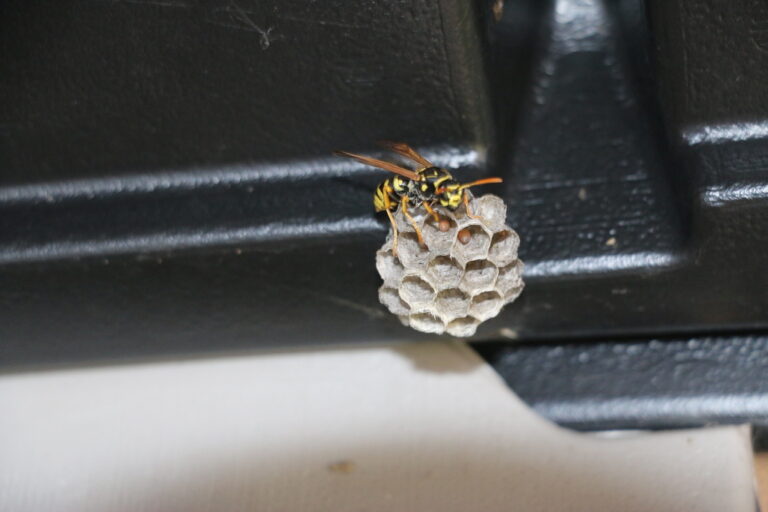
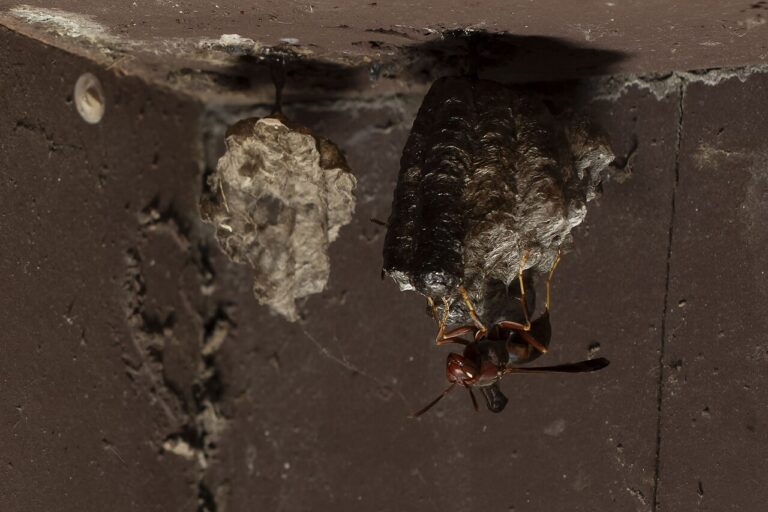
Paper wasp nests look like an open, upside-down umbrella of gray or brown paper cells hanging from a short stalk. You can see the cells from below, and there is no outer paper shell. They are usually a few inches across, sometimes up to 6 to 8 inches by late summer, with a few dozen wasps. Look under eaves, porch ceilings, railings, shutters, light fixtures, grills and mailboxes.
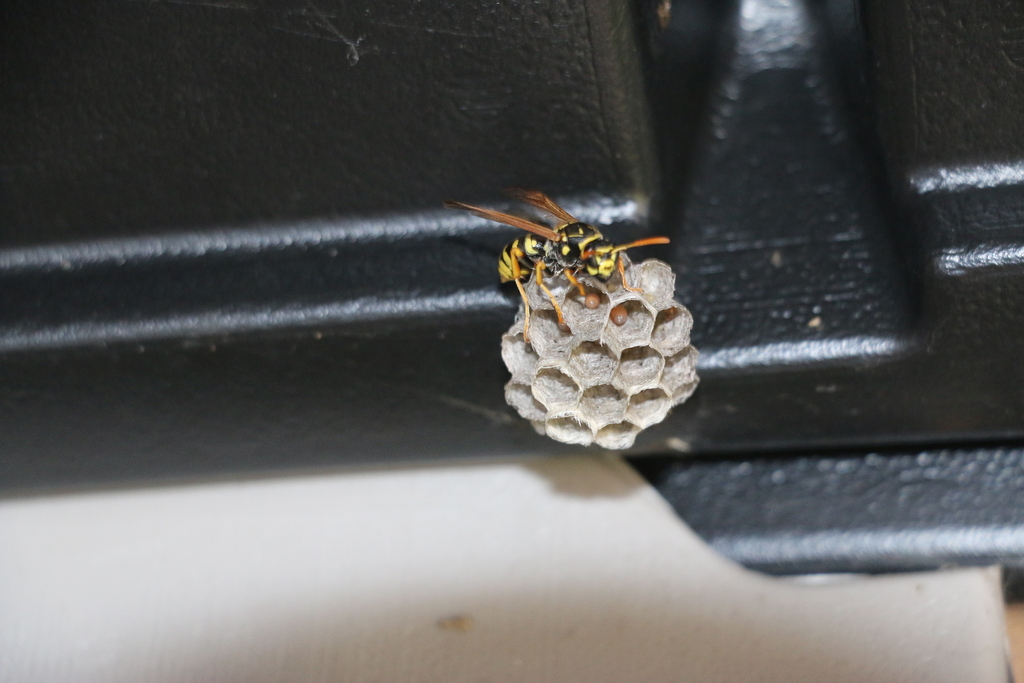
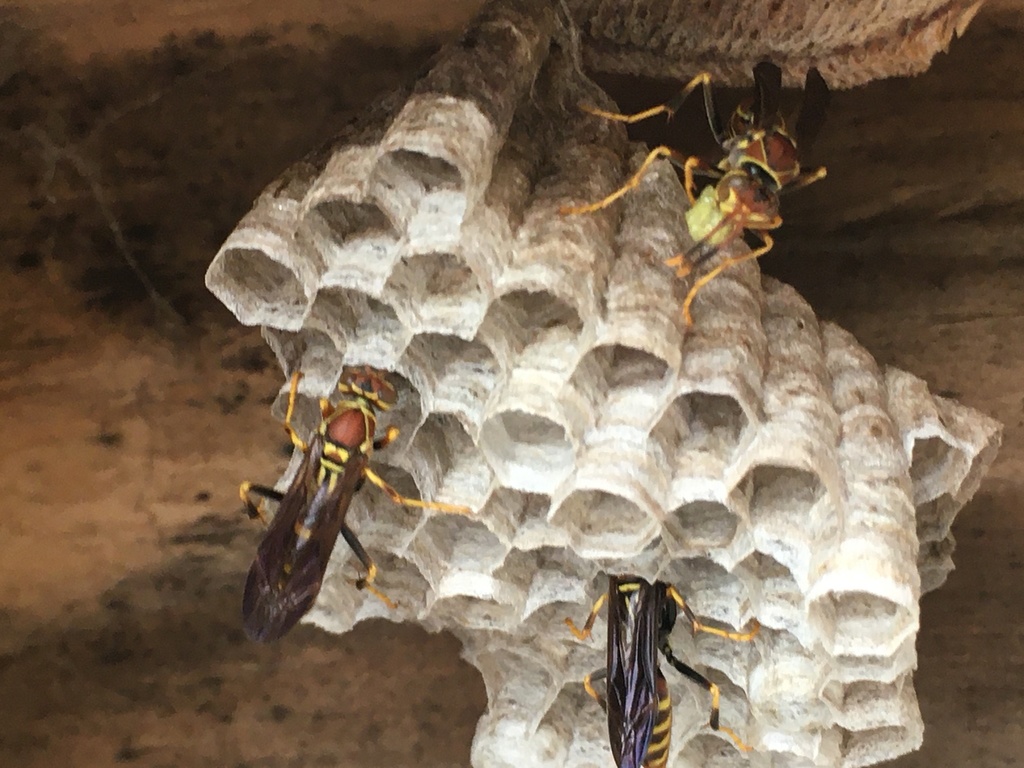
If the nest is a closed, football- or ball-shaped paper globe, it belongs to yellowjackets or bald-faced hornets, and this method is not enough. If wasps fly in and out of a hole in the ground or a wall, see ground nests or a nest in a wall. Not sure? Compare types of wasp nests and read more about paper wasp nests.
Does it need to go?
Paper wasps are not very aggressive away from the nest, and they hunt caterpillars and other garden pests. A nest at the far corner of a shed or high on a quiet wall can often be left alone: the colony dies off after a hard frost, and the old nest is not reused. Remove it if it is next to a door, a deck, a grill, play equipment or a mailbox, anywhere people brush past it every day. More: should you remove a wasp nest.
When to do it
- Spring is easiest. A new nest with one queen and a handful of cells can be knocked down with a long-handled broom, and the queen often gives up on the spot.
- Evening or early morning in summer, when nearly all the wasps are on the nest and calmer, but there is still enough light to see it. Night treatment works well if you can see the nest without shining a bright light at it.
- After a hard frost the nest is empty. Just scrape it off.
More on the calendar: the best time to remove a wasp nest.
What you need
- An aerosol wasp and hornet spray with a jet stream. Many reach 15 to 20 feet. See how to choose a wasp spray.
- Long sleeves, long pants, gloves, closed shoes and eye protection. A hat or a beekeeper veil helps.
- A long-handled broom, scraper or stick, and a trash bag.
- A clear path to walk away, and everyone else (and pets) indoors.
Step by step
- Read the label of the spray: spray distance, wind, surfaces it can stain and nearby plants it can harm.
- Wait for evening on a calm day. Close nearby windows and doors and bring pets in.
- Stand to the side and upwind, at the distance the label gives. Never stand directly under the nest: sprayed wasps drop fast, and spray drifts down.
- Spray the whole face of the comb for the time the label says, until it is soaked. Then walk away calmly. Do not stay to watch.
- Wait at least a day. Check from a distance. If wasps are still flying, repeat in the evening.
- Knock the nest down with the broom or scraper once it is quiet, wearing gloves. Bag it and put it in the trash.
- Scrape off the stalk and any paper left on the surface, and wash the spot. A clean surface makes the place less attractive to the next queen.
- Check again over the next weeks. A few returning wasps may hover around the spot for a day or two. New nests can appear nearby, especially in spring.
Tricky spots
| Where | What to do |
|---|---|
| Inside a grill | Do not light it to burn them out. Treat in the evening with the lid cracked, wait a day, then remove the nest and clean the grill well before cooking. |
| Mailbox, light fixture, shutter | Open the space only in the evening. Spray into the gap per the label, wait, then remove the nest. Check these spots every spring. |
| Play equipment | Keep children away until the nest is gone and the surface is cleaned. Check the hollow tubes and the underside of slides and decks. |
| High eaves, second floor | Do not spray from a ladder: a few stings can cause a fall. Use a long-reach spray from the ground if the label allows, or call a professional. |
| Hidden in a vent or wall | This is no longer an open nest. Do not seal the hole. See a nest in a wall. |
What not to do
- Do not use fire, gasoline or other flammable liquids, and do not spray near an open flame or pilot light.
- Do not knock down a large active nest in the middle of the day.
- Do not hit the nest with a hose or throw things at it.
- Do not spray while standing on a ladder.
If you get stung: move away, wash the sting and use something cold. Call 911 for trouble breathing, throat swelling or hives away from the sting. See wasp sting first aid and wasp sting allergy.
Keeping them from coming back
- Walk around the house every week or two in spring and knock down any small nest you find while it has only one queen.
- Screen attic vents and seal gaps under siding and trim, where queens shelter over winter.
- Old nests are not reused, but the sheltered spot is. Scrape and wash where nests have been.
More: how to prevent wasp nests. Paper wasps found indoors in winter are usually queens looking for shelter: see wasps in the house.
When to call a professional
- Anyone in the household is allergic to stings.
- The nest is high up, over a doorway you cannot avoid, or in several places at once.
- It is inside a wall, vent or roofline rather than hanging in the open.
- You are not comfortable doing it. That is reason enough.
Paper wasp nests are among the cheapest jobs for a pest control company, often about $100 to $400. See wasp nest removal cost and when to call a professional.
Common questions
Do paper wasps come back to the same nest?
No. Each colony builds a new nest in spring, and the old one is abandoned. New queens may still choose the same sheltered spot, so remove the old nest and check the area in spring.
Can I remove a paper wasp nest during the day?
A small spring nest, yes. For an active summer nest, evening is safer because more wasps are on the nest and they are less active. If you must treat in daylight, never stand underneath it.
Are paper wasps aggressive?
Not usually. They sting to defend the nest, most often when someone bumps it without seeing it, for example while opening a shutter or a grill.
Should I spray the nest or just knock it down?
Knock down only a tiny spring nest. Knocking down an active summer nest leaves dozens of angry wasps around you. Spray first, wait, then knock it down.
Your next step
- Other nests and places: all removal guides and the general how to get rid of a wasp nest.
- Is the nest even active? How to tell if a wasp nest is active.
More in Removal
 Wasps in the House: Where They Come FromA wasp buzzing against a window is usually nothing more than a lost visitor. A few slow wasps…
 What Not to Do With a Wasp NestMost bad stings around wasp nests come from a few predictable mistakes: disturbing the nest in the…
 How to Get Rid of a Wasp Nest SafelyA small wasp nest you can reach from the ground is often a job you can do yourself in one evening.…
 Wasp Nest Under EavesMost nests under eaves, soffits and porch ceilings are paper wasp nests: an open comb, like an…
 Wasps in the Chimney: What to DoWasps flying around the chimney top or showing up by the fireplace usually come from a yellowjacket…
Sources
- Controlling Paper Wasps in and around Structures, NC State Extension, 2018.
- Paper Wasps, University of Maryland Extension, updated 2023.
- Controlling Wasps, Hornets and Yellowjackets (ENTFACT-620), Michael F. Potter, University of Kentucky Entomology, revised 2018.
Photos on this page are shared by their authors on iNaturalist under Creative Commons licenses, credited under each image. For who writes these guides and how we stay independent, see About.