
How to get rid of a yellowjacket ground nest
Updated
Yellowjackets streaming in and out of a hole in the lawn are one of the most common late-summer stinging problems, and one of the easiest to make worse. The colony lives underground, out of sight, and it can hold thousands of wasps by fall. This guide helps you confirm what you have, decide whether it needs to go at all, and, if it does, treat a small nest safely at night or hand it to a professional.
Short answer
If a yellowjacket ground nest is away from paths, play areas and the house, the simplest option is to mark it and leave it: the colony dies on its own after hard frosts and is not reused. If it has to go, find the single entrance during the day, then after dark treat the opening with an insecticide dust or a wasp and hornet product labeled for ground nests, following the label exactly. Walk away, do not plug or flood the hole, and check for activity a day or two later. Call a professional if anyone at home is allergic, the entrance is next to the house foundation, or the nest is large and busy.
Is this the right guide? This guide is about yellowjackets nesting underground: one busy entrance and no pile of soil. Many small holes with little soil mounds in spring are usually ground-nesting bees, a different and mostly harmless situation; see bees nesting in the ground. If the entrance is right at the foundation or in a gap in the siding, the colony may be inside the house; see wasp nest in a wall. Wasps going in and out under a deck or porch? See wasp nest under a deck. In Georgia, also see wasps in Georgia.
First, make sure it is yellowjackets
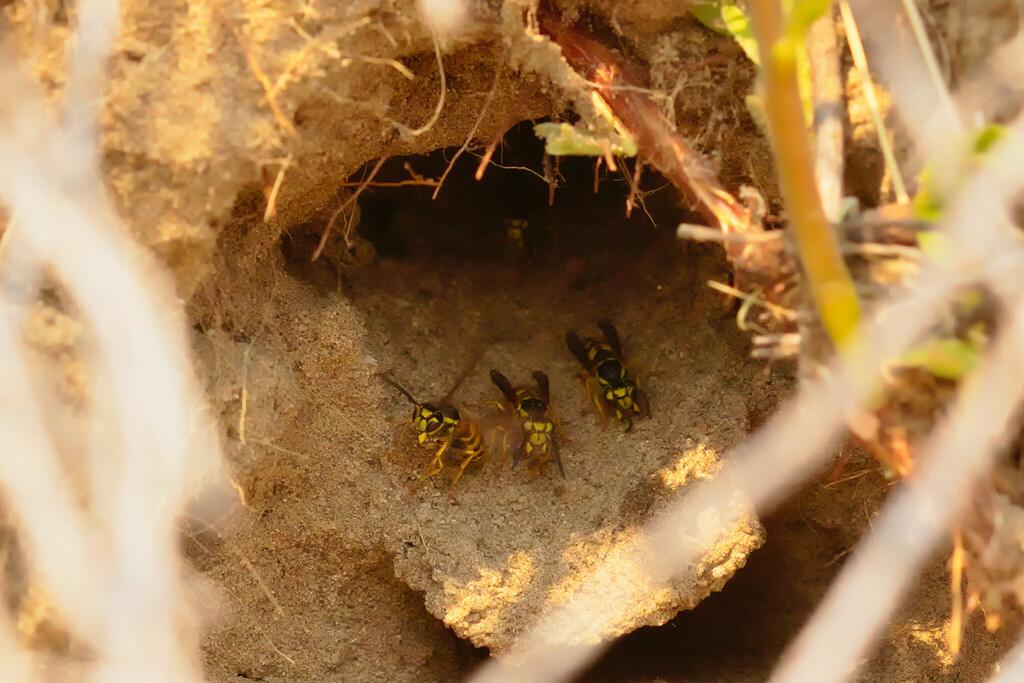
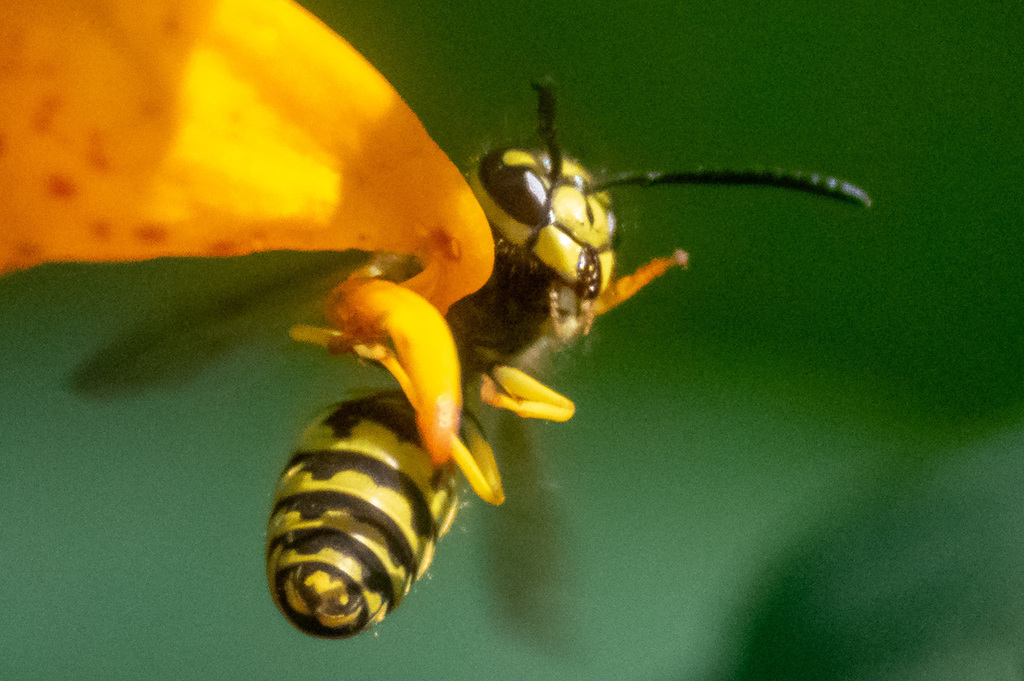
Several insects nest in the ground, and most of them are harmless. Yellowjackets are hairless, shiny, sharply banded black and yellow wasps, about half an inch long. Their nest has one main entrance, often an old rodent burrow or a gap under roots or a stone, with a steady stream of wasps flying straight in and out. You usually see no pile of soil. More on telling them apart: wasp vs. bee and yellowjacket nests.
| What you see | Likely insect | What to do |
|---|---|---|
| One hole, constant traffic of shiny black-and-yellow wasps, summer to fall | Yellowjackets | Read on |
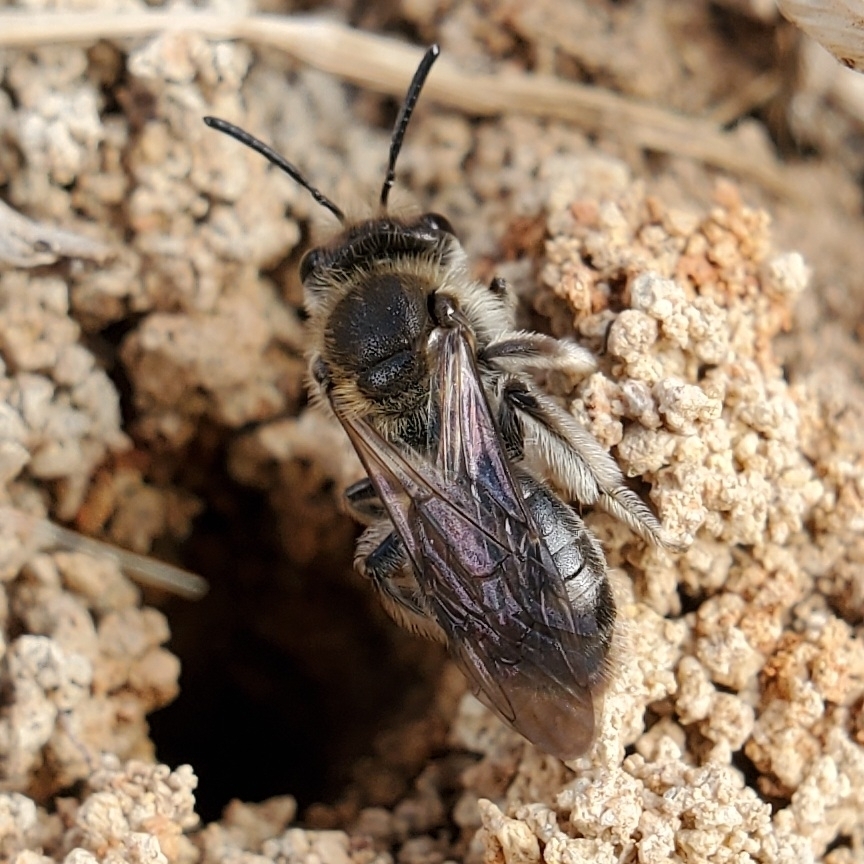
| Dozens of small holes with little soil mounds in bare or sandy lawn, early spring | Ground-nesting bees (mining bees) | Leave them; they rarely sting and are gone in a few weeks. See bees nesting in the ground |
| Fuzzy, round bees using an old burrow or a hole under a shed | Bumblebees | Leave if out of the way; colonies end in late summer. See bumblebee vs. wasp vs. hornet |
| Very large wasps, one per hole, with a fan of soil, in midsummer | Cicada killers | Usually leave; males hover but cannot sting. See cicada killer wasps |
Does it need to go?
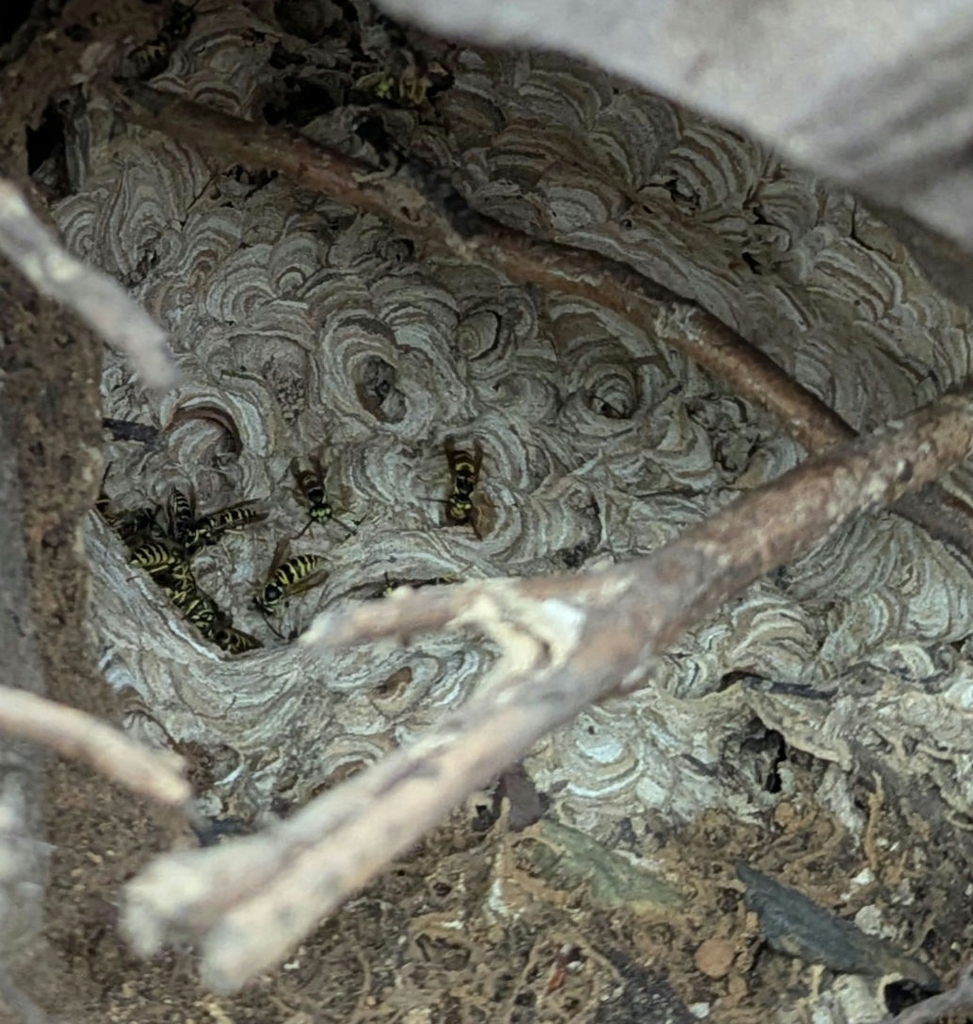
Not always. A yellowjacket colony starts from a single queen in spring, stays small through early summer and can reach about 5,000 wasps by September. In fall, the colony raises new queens, which mate and leave to spend the winter elsewhere. The rest of the colony dies after hard frosts, and the old nest is never used again. Yellowjackets also eat many garden pests.
- Usually fine to leave: a nest at the back of the yard, in a bed you do not work in, or one you find in October or November in a cold-winter area. Mark the spot with a stake or flag a few feet away and keep people, pets and mowers clear.
- Deal with it: a nest in the lawn you mow, next to a path, door, deck, play area or dog run, or anywhere someone has already been stung.
Still deciding: should you remove a wasp nest or leave it. Not sure the nest is still active: how to tell if a wasp nest is active.
DIY or professional?
A ground nest is harder than an exposed paper wasp nest: you cannot see how big the colony is, and every wasp that is out when you treat comes back to the same hole. DIY is reasonable only when all of these are true:
- you have found one entrance and watched it from a distance;
- traffic is light to moderate, a wasp every few seconds rather than a constant stream;
- the hole is in open ground, not against the foundation, steps, a patio slab or a wall;
- no one in the household is allergic to stings, and you can keep children and pets indoors.
Call a professional if anyone at home is allergic or carries an epinephrine auto-injector; if the entrance is next to the house, where the nest may run into a wall void (see wasp nest in a wall); if there is more than one entrance or you cannot find it; if the colony is large and busy in late summer; or if you have already been chased. See when to call a professional for wasps and DIY vs. professional removal.
Find and mark the entrance
Do this in daylight, from at least 10 feet away and from the side, never standing in the line the wasps fly. Watch where returning wasps drop down. Mark the spot with a stake or flag placed a few feet beside the hole, not on it, so you can find it in the dark. Note your route back indoors. Do not poke the hole, mow over it or stand on it; vibration sets off the colony.
What you need
- A product labeled for yellowjacket ground nests. Extension services commonly suggest an insecticide dust puffed into the entrance: returning wasps carry it inside to the rest of the colony. A wasp and hornet aerosol that sprays 10 feet or more also works on the opening and acts faster. Read the whole label before you buy and follow it; the label is the law for how a pesticide is used. More: how to choose a wasp and hornet spray.
- For dust, a hand duster or the applicator the product comes with, so you can stay at arm’s length or more. More: how wasp dust works at a nest entrance.
- Protective clothing: long sleeves and long pants, gloves, closed shoes, socks over pant legs, a hat or hood, and eye protection. A bee veil is a good idea.
- A light you do not hold: wasps that come out fly toward a light. Set a flashlight with a red filter on the ground a few feet away, aimed near the entrance, and approach from another side.
Step by step: treating a small ground nest at night
- Pick a calm, dry evening. Rain washes dust away and wind blows it back at you.
- Prepare the area. Bring children and pets inside, close nearby doors and windows, and tell everyone at home what you are doing.
- Read the label again: how much to apply, how close to stand and when you may re-treat.
- Get dressed in your protective clothing and wait until it is fully dark, when almost all the wasps are inside and they do not fly well.
- Set your light down near the marker, then approach slowly and quietly from the side, avoiding heavy steps.
- Treat the entrance as the label directs: with dust, a few puffs into and around the opening; with an aerosol, a stream into the hole.
- Walk away immediately along your planned route and go indoors.
- Leave the hole open. Do not cover, plug or flood it. With dust, the wasps need to walk through the opening to carry it in.
- Check from a distance on a warm afternoon one to three days later. Dust usually takes a few days. If wasps are still coming and going, re-treat once at night as the label allows, or call a professional.
- Wait until all activity has stopped for several days before you fill the hole with soil. Young wasps can keep emerging from the comb for days after the treatment. You do not need to dig the nest out.
Stop at any point if wasps start pouring out, if the hole turns out to be at the foundation, or if you find more than one entrance. Back away calmly, go indoors and call a professional.
What not to do
- No gasoline, fuel or fire. Pouring fuel down a hole is dangerous, pollutes the soil and groundwater, and often fails anyway.
- Do not plug, bury or flood the hole while the colony is alive. The wasps dig out somewhere else, sometimes into a basement or wall.
- No boiling water. It rarely reaches the whole nest, it can scald you, and it sends the survivors after you.
- Do not mow, dig or run a string trimmer near an active nest.
- Do not treat in daylight or stand in the flight path.
- Do not use a product in a way the label does not allow, or mix your own chemicals.
Traps catch foragers but do not kill a ground colony; they help at a picnic table, not over a nest. For the full list of common mistakes, see what not to do with a wasp nest.
If the wasps come after you
Yellowjackets can sting many times, and a disturbed ground colony sends out a lot of defenders at once. Cover your face, move away quickly in a straight line and get indoors or into a car. Do not swat and do not jump into water. Once you are safe, remove any wasps caught in clothing. For ordinary stings, see what to do first.
Call 911
Call 911 right away if someone who was stung has trouble breathing, swelling of the lips, tongue or throat, hives spreading beyond the stings, dizziness or fainting, or has been stung many times. Use a prescribed epinephrine auto-injector if one is available.
Timing matters
- Early summer: nests are small and easiest to handle; if you notice traffic in June, act then.
- Late summer and early fall: colonies are at their largest and most defensive, and workers sometimes sting without being provoked. This is the time to lean toward a professional.
- After hard frosts: the colony is dying; if nobody needs that patch of lawn, wait.
More detail: the best time to remove a wasp nest.
What a professional does
A licensed pest professional comes with full protective gear, professional dusts and the experience to judge whether the nest runs under a slab or into the house. Most treat the entrance once, at dusk or at night, and check back if needed. Yellowjacket nests are usually priced higher than small paper wasp nests; see what wasp nest removal costs for current ranges, and the general method in how to get rid of a wasp nest.
We are an independent guide and do not do removals or sell products. When a ground nest is a job for a professional, we would rather point you to one than have you get stung.
Preventing next year’s nest
Old nests are not reused, but the same yard may suit a new queen next spring. Fill old rodent burrows and gaps under steps and stones in early spring, keep an eye on bare spots in the lawn in May and June, and keep garbage and pet food covered in late summer. More: how to prevent wasp nests.
Common questions
How many yellowjackets are in a ground nest?
A few dozen in early summer, and up to several thousand by September in a large colony. The small hole gives no hint of the size of the nest below.
How deep is a yellowjacket ground nest?
The nest sits in a cavity a few inches to a foot or more below the surface, often an old rodent burrow the wasps have enlarged. That is why liquids poured from above rarely reach all of it.
Will they come back to the same hole next year?
No. The colony dies in fall and new queens start fresh nests in spring, though a yard with many burrows can attract a new queen nearby.
Can I just cover the hole with a bowl or soil?
Not while the colony is alive. The wasps dig a new exit, and you no longer know where it is. Fill the hole only after activity has stopped for several days.
Is it safe to mow near the nest?
No. Mower vibration is one of the most common reasons people get stung by ground nests. Mark the spot and leave a wide unmowed circle until the nest is dealt with.
Your next step
- Still not sure what is nesting there: types of wasp nests and all identification guides.
- Weighing your options: the wasp nest decision guide.
- All removal guides: wasp nest removal.
More in Removal
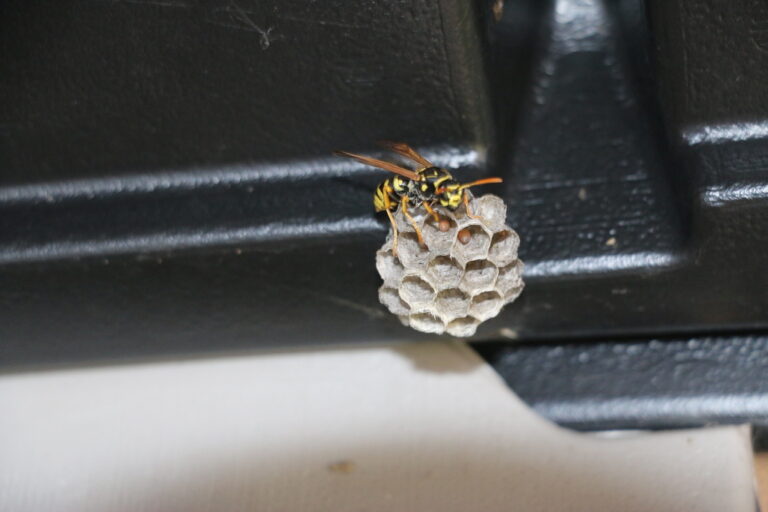 How to Get Rid of a Wasp Nest SafelyA small wasp nest you can reach from the ground is often a job you can do yourself in one evening.…
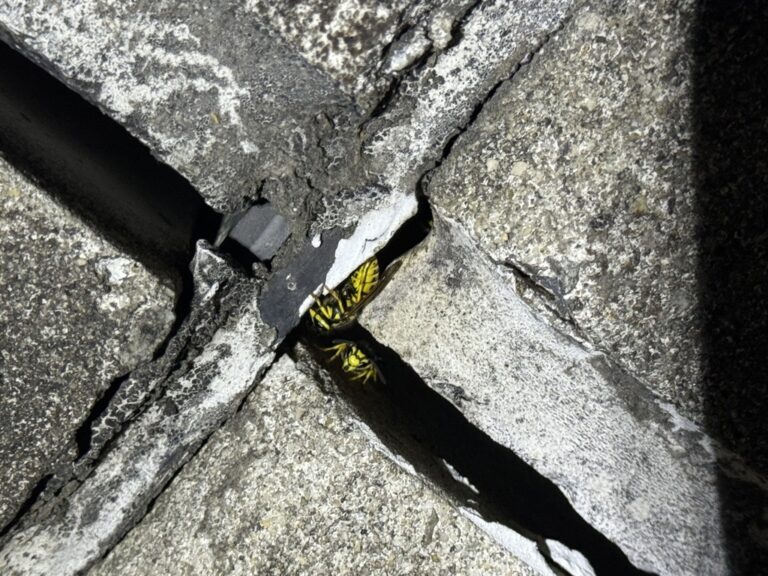 Wasp Nest in a Wall: Why Not to Seal ItWasps flying in and out of a crack in your siding, a gap under the trim or a vent usually mean a…Best Time to Remove a Wasp NestWhen you deal with a wasp nest matters almost as much as how. The same nest that takes two minutes…
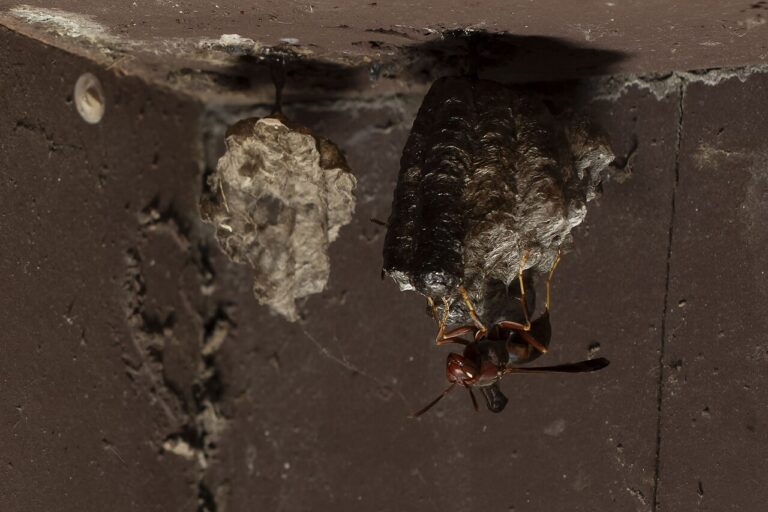 Wasp Nest Under EavesMost nests under eaves, soffits and porch ceilings are paper wasp nests: an open comb, like an…What Not to Do With a Wasp NestMost bad stings around wasp nests come from a few predictable mistakes: disturbing the nest in the…
Sources
- Yellowjacket Wasps, Iowa State University Extension, Horticulture and Home Pest News.
- Yellowjacket in Turf, NC State Extension, revised 2022.
- Yellowjackets, Washington State University Pestsense, reviewed 2025.
- Yellowjacket Control Method, Mississippi State University Extension, Bug’s Eye View, 2018.
Photos on this page are shared by their authors on iNaturalist under Creative Commons licenses, credited under each image. For who writes these guides and how we stay independent, see About.