
Wasp nest in a tree or bush: leave it or remove it?
Updated
Short answer
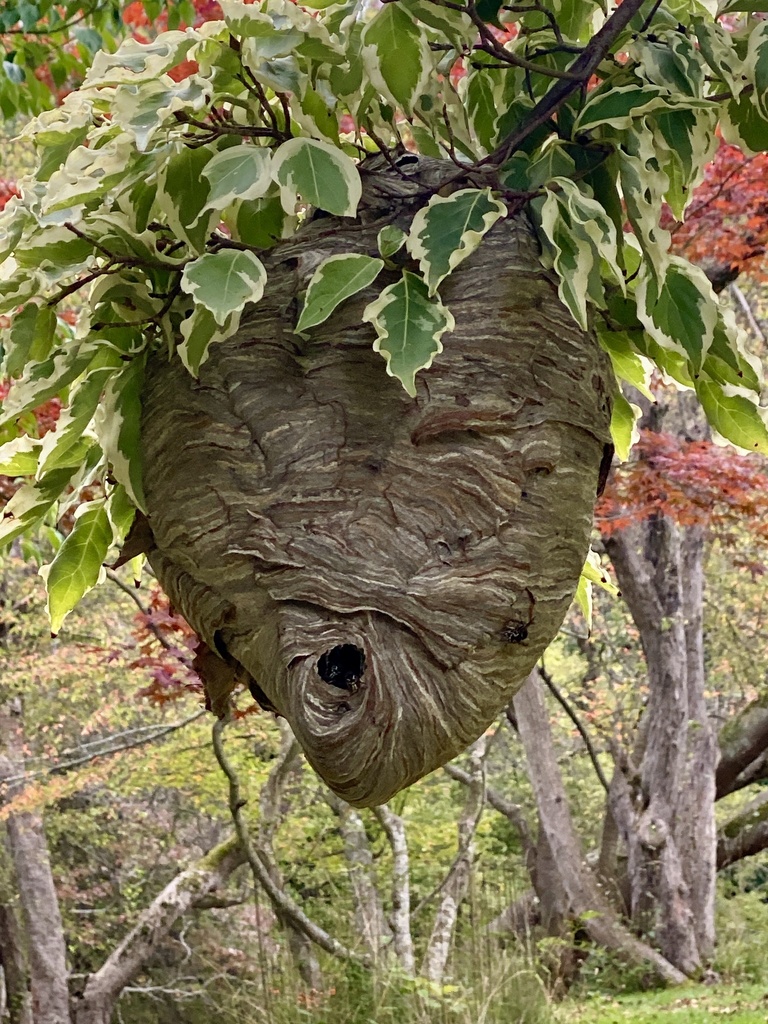
A paper nest high in a tree, away from paths and play areas, can usually be left alone. It does not hurt the tree, the colony dies off with hard frosts, and wasps do not reuse an old nest. A nest at head height, over a walkway, in a hedge you need to trim, or near someone allergic to stings is different: keep people and pets away and plan removal, usually at night or by a professional. Most tree nests belong to bald-faced hornets or aerial yellowjackets, which defend the nest hard, so do not hit, shoot, hose or burn it.
Is this the right guide? This page covers nests hanging in trees and shrubs and nests inside hollow trunks. For a gray paper ball you have already identified, see bald-faced hornet nests. For nests on the house, see wasp nests under eaves, decks and roofs. Big brown hornets going in and out of a hole in a trunk are often European hornets, and a hole in the lawn under the tree is a yellowjacket ground nest. Nest on a swing set or kids’ playhouse under the tree? See wasp nest in a playhouse or swing set.
Who built the nest in your tree?
| What you see | Likely builder | What it means |
|---|---|---|
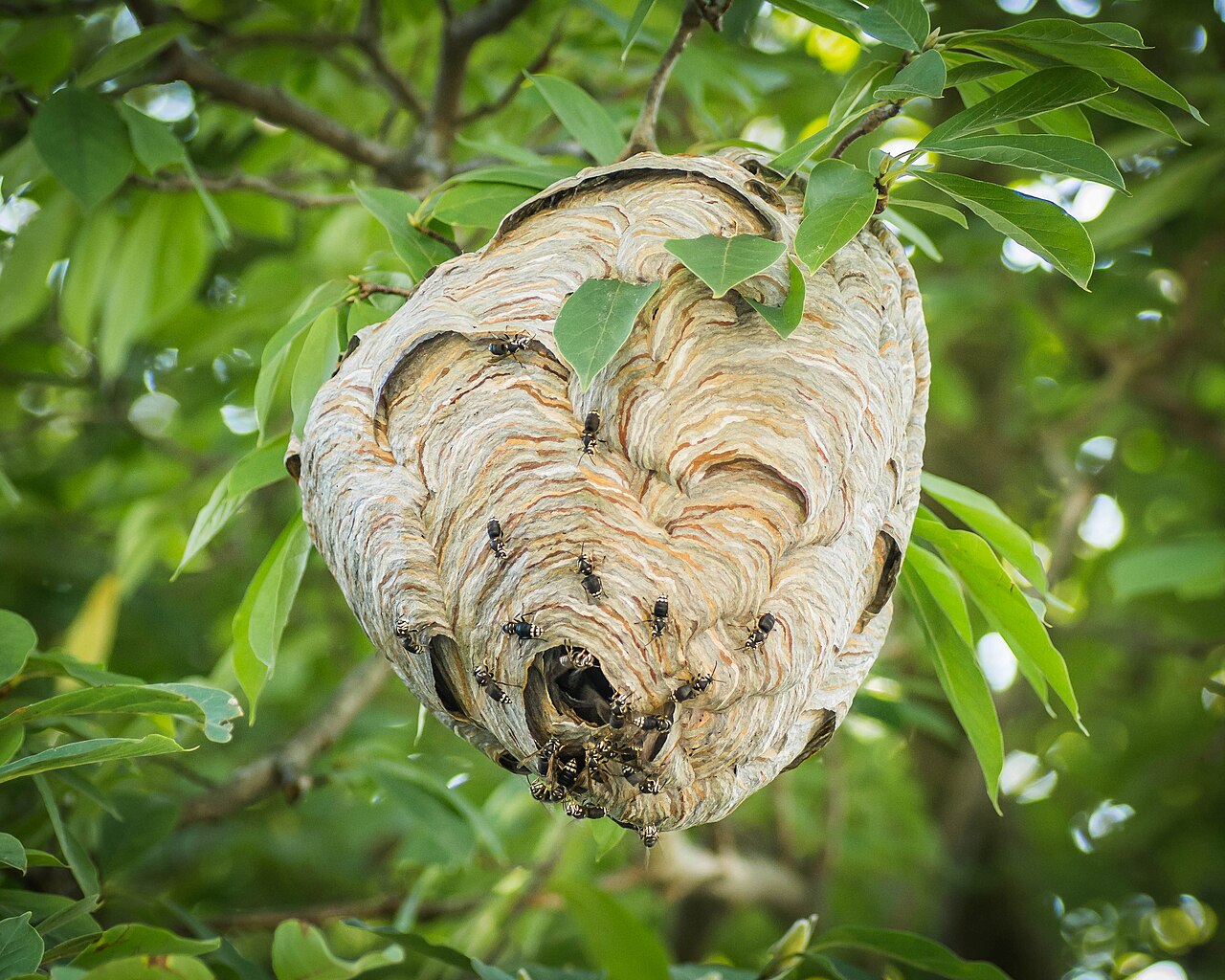
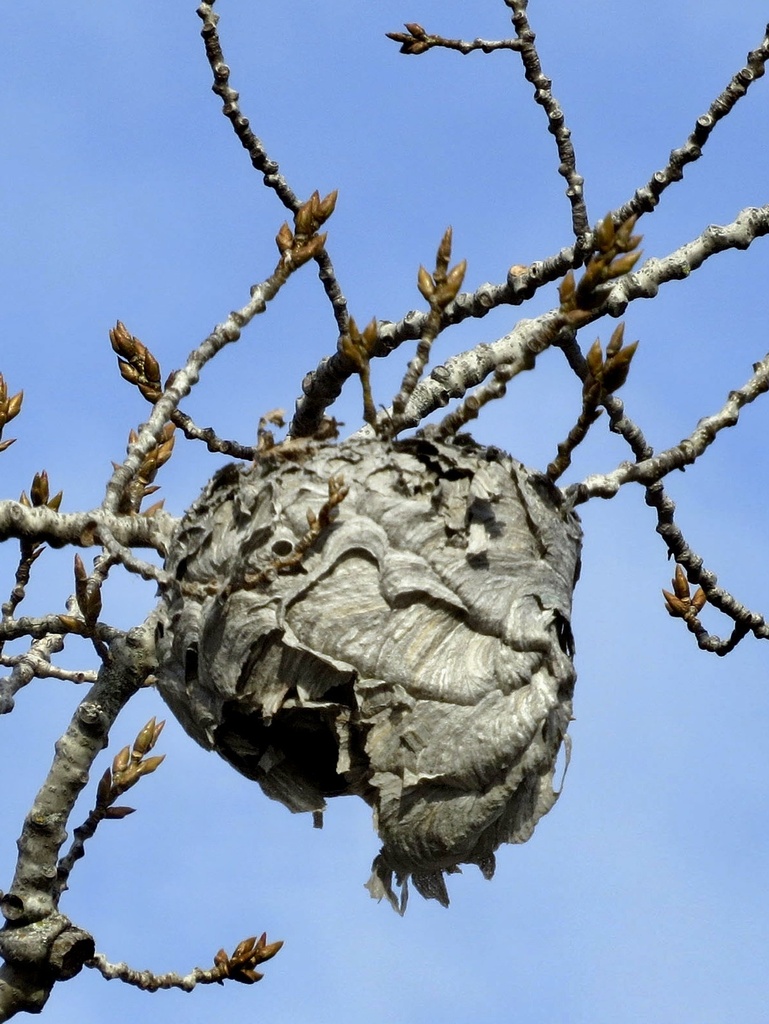
| Gray paper ball or football, one hole near the bottom, hanging from a branch | Bald-faced hornet (a large black-and-white aerial yellowjacket) | Defends the nest strongly. Often noticed only after the leaves fall, when it is already empty. |
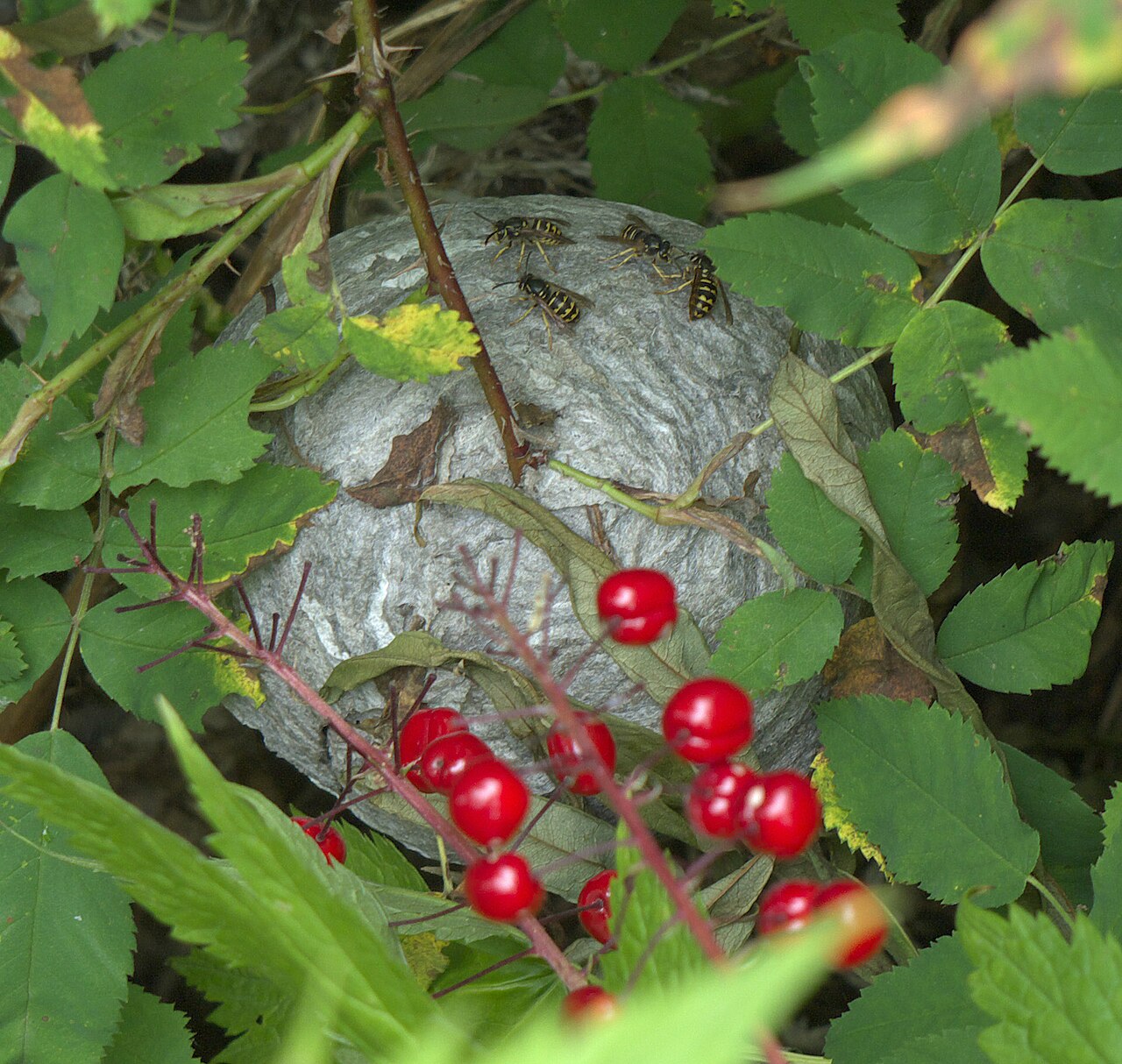
| Smaller gray paper ball tucked inside a shrub or low branches | Aerial yellowjacket | Easy to bump while trimming or mowing; stings come fast. |
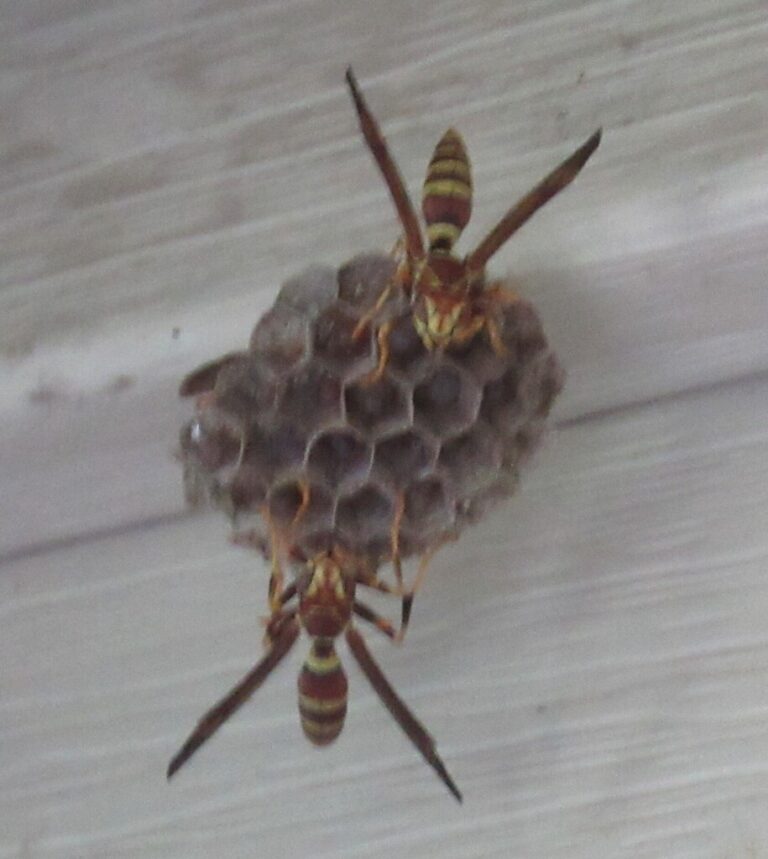
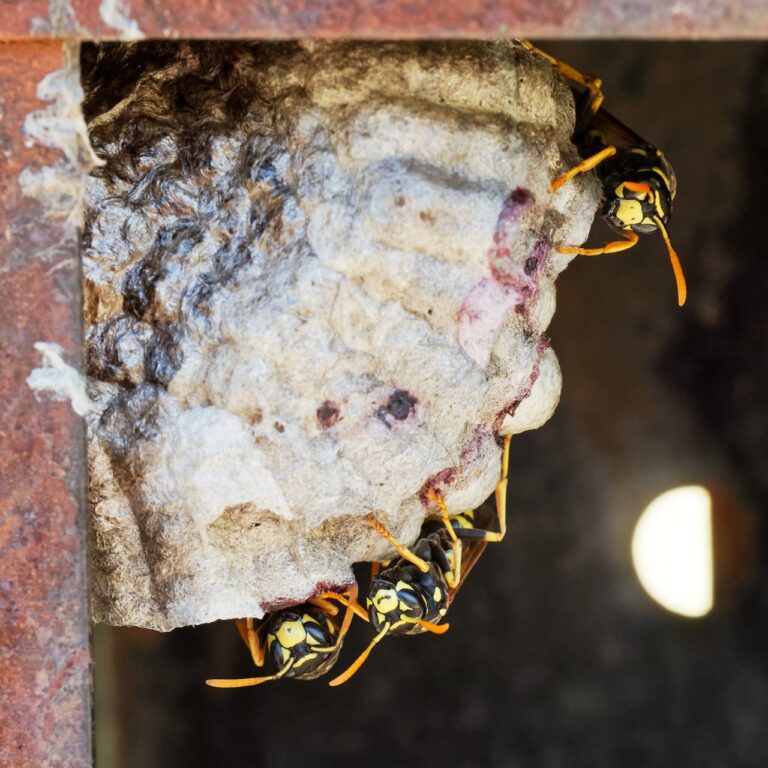
| Open, umbrella-shaped comb with no paper cover, on a twig | Paper wasp | Smaller colony and usually calmer. See paper wasp nests. |
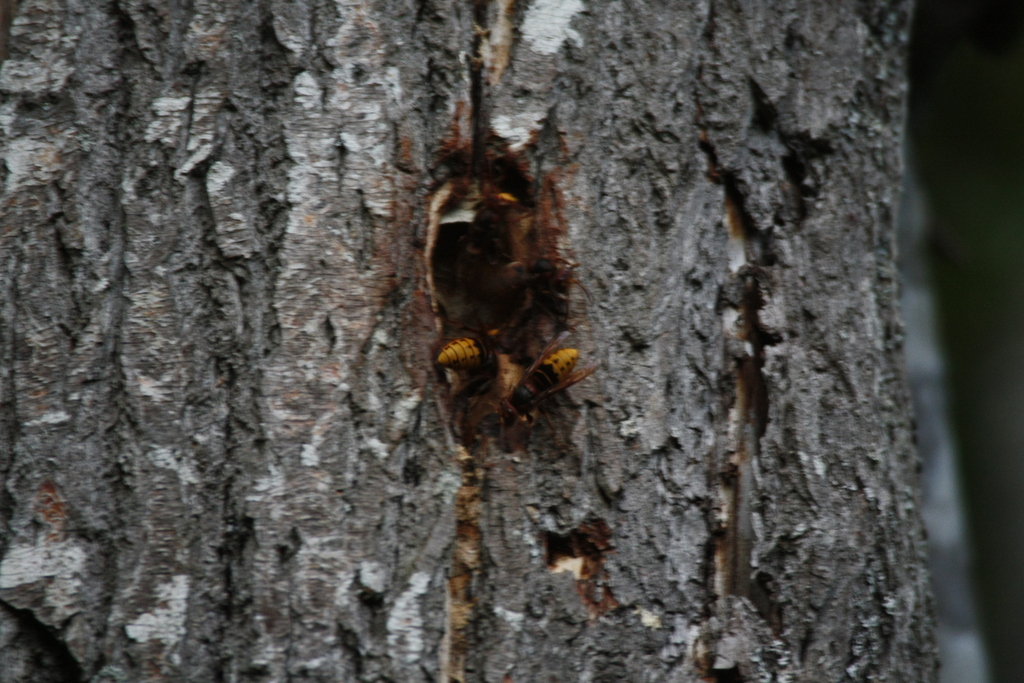
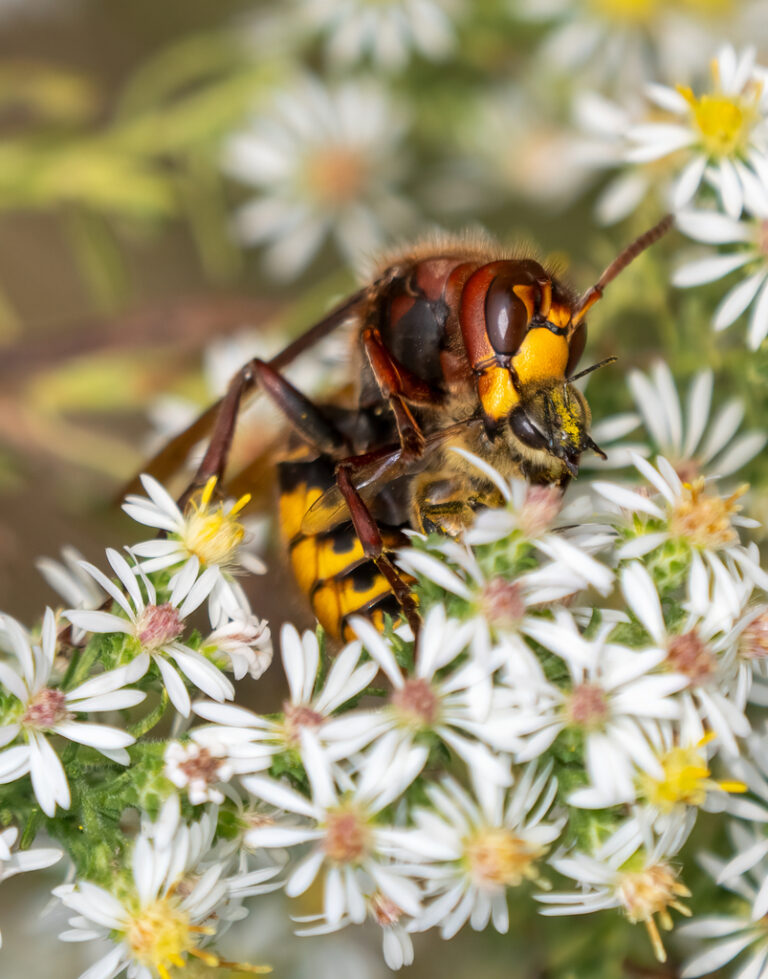
| Large brown hornets flying in and out of a hole in the trunk, often 6 feet or higher, sometimes at night | European hornet | The nest is hidden inside the hollow tree, so it cannot be knocked down. Usually a job for a professional. |
| Wasps coming out of the ground at the base of the tree | Ground-nesting yellowjackets | Not a tree nest. See the ground nest guide. |
When you can leave it alone
Extension entomologists give the same advice again and again: if a tree nest is out of the way, the safest choice is to leave it. Here is why that works:
- It ends on its own. Workers die with hard frosts. Only young queens survive the winter, and they hide elsewhere, under bark or in sheltered spots, not in the nest.
- It is not reused. Next spring each queen builds a new nest. The old one slowly falls apart; birds pick it open and wind and rain shred it.
- It does not hurt the tree. The nest hangs on the branch and does no damage to it.
- The wasps help you. Bald-faced hornets and other aerial yellowjackets hunt flies, caterpillars and other soft-bodied insects.
Leaving it is reasonable when the nest is high, at least 10 to 20 feet from doors, paths, the patio and play areas, and nobody in the home is allergic to stings. Tell family members where it is, and mow and trim at a distance. In the far South, where winters are mild, some colonies keep going through the winter, so do not assume a nest there is empty just because it is November.
When it has to go
- The nest is at head height or lower, or hangs over a walkway, driveway, deck or play set.
- It is in a hedge or shrub you must trim, or next to where you mow.
- Someone in the home has had a serious reaction to a sting, or children and dogs use that part of the yard every day.
- Wasps are already chasing people who pass by.
Until it is dealt with, rope or tape off the area so people and pets stay away, and use another door or path if you can.
Your options, from safest
- Wait it out. In late summer and fall, the simplest plan is to keep everyone away until a few hard frosts. Watch the entrance on a warm afternoon from 20 feet away; no traffic for several days means it is done. See how to tell if a wasp nest is active.
- Knock down an empty nest. Once it is clearly empty, you can pull it off with a long pole or gloved hands from a stable step stool. There is no need to cut the branch. If you want to keep it as a curiosity, do not spray it.
- A small paper wasp nest you can reach from the ground. This is the one tree nest many homeowners can handle themselves, after dark, with a wasp spray used exactly as the label says. Do not stand directly under the nest. Step by step: how to remove a paper wasp nest.
- An active hornet or yellowjacket ball nest, or anything you need a ladder for. Call a pest control professional. Hundreds of defending wasps plus a ladder is how people get badly stung and fall. Professionals work at night with protective suits and extension tools.
- Hornets in a hollow trunk. The nest is inside the tree, so knocking it down is not possible. A professional treats the opening; an arborist may also need to look at the tree.
Never do this: shoot the nest, hit it with a stick or a ball, blast it with a hose, or use fire or gasoline. These release a cloud of angry wasps and can start a fire in a dry tree. More in what not to do with a wasp nest.
Before you trim hedges or prune
Many bad stings happen with hedge trimmers in hand: the vibration reaches a nest you never saw. Before you start, stand back for a few minutes on a warm, sunny day and watch the shrub. Several wasps flying in and out of the same spot mean a nest. If you find one, stop, mark the spot, and either work on another part of the yard until frost or have the nest removed first.
If you hire it out
Height and access drive the price: a nest you can reach from the ground costs less than one that needs a tall ladder or a lift, and hollow-tree nests take more work. See typical prices in hornet nest removal cost and wasp nest removal cost, and our list of when to call a professional.
Common questions
Will the wasps come back to the same tree next year?
Not to the old nest. A new queen may pick a nearby tree or the same tree again in spring, so check the yard for small new nests in May and June, when they are the size of a golf ball and easy to deal with.
Can I cut off the branch with the nest?
Only once the nest is empty. Cutting a branch with an active nest shakes it and brings out the whole colony. In winter you rarely need to cut anything: the nest pulls off easily.
The nest is very high. Do I need to do anything?
Usually not. A nest 20 or more feet up that nobody walks under is unlikely to cause stings, and it will be empty after hard frosts. If you live where the invasive yellow-legged hornet has been found and see a very large nest high in a tree, report it to your state department of agriculture instead of touching it.
Is it a bee nest?
Honey bees in a tree build wax combs, often in a cavity or as an exposed swarm, not a gray paper ball. A cluster of bees hanging on a branch is usually a swarm resting for a day or two; call a local beekeeper rather than spraying.
Your next step
- Not sure if anyone is home: check whether the nest is active.
- Decide what to do: the wasp nest decision guide.
- All removal guides: wasp nest removal.
More in Removal
 Bald-Faced Hornet NestsA big gray paper ball hanging in a tree, a hedge or under the eaves is one of the most alarming…
 European HornetThe European hornet is the only true hornet in the eastern U.S. and the largest one you are likely…
 What Not to Do With a Wasp NestMost bad stings around wasp nests come from a few predictable mistakes: disturbing the nest in the…
 Under eaves, decks and roofsExposed nests on the house, from easy to ladder jobs.
 Wasp Nest in a MailboxMost mailbox nests are paper wasps. How to open the box safely, remove the nest and get your mail delivered again…
Sources
- Baldfaced Aerial Yellowjacket (ENTO-620NP), Virginia Cooperative Extension, revised 2025.
- Yellowjackets and baldfaced hornets, Cornell University Integrated Pest Management.
- Yellowjackets, Oregon State University Extension, Solve Pest Problems.
- European Hornets and Look-Alikes, Ohio State University Extension, 2025.
- European Hornet, NC State Extension.
- Baldfaced hornet: dangerous bug or beneficial insect?, University of Illinois Extension, 2022.
- Ask Extension: wasp nest in a tree, Michigan State University Extension expert answer.
This guide is general information. If you use an insecticide, follow its label exactly. Photos on this page are shared by their authors on Wikimedia Commons and iNaturalist under Creative Commons licenses, credited under each image. For who writes these guides and how we stay independent, see About.